

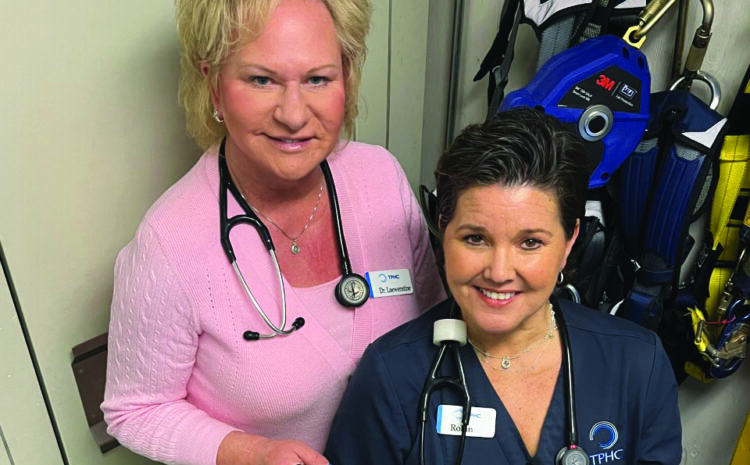
TPHC assesses firefighters, police, others for potential health issues
Tristate Preventive Health Consultants likes to say it’s in the business of saving the lives of those who save lives.
The 15-year-old company dives deeply into occupational-health data, focusing mostly on first responders, particularly firefighters and police officers.
Why, for instance, are firefighters suffering cancer rates at a higher rate than the general population?
That’s what intrigues Dr. Virginia Loewenstine, founder, CEO and medical director of TPHC. Loewenstine, board-certified as a family-practice physician, began working in occupational and preventive-health medicine more than 30 years ago. She also has served as national medical director for several corporations.
Tristate Preventive Health Consultants is Loewenstine’s medical practice, but it’s unlike a doctor office—TPHC operates as more of a specialty.
“We do occupational preventive health,” Loewenstine says, noting that she and her team go on-site to fire departments, police departments and companies to conduct wellness physicals, medical screening, medical surveillance and medical testing, to monitor employees’ potential exposure to health hazards.
“We don’t see people like a regular doctor,” she says. “We don’t take insurance. I do not have a physical practice for the public to come to.” When she does notice something during screenings at one of her customer organizations, she tells the employee to go see his or her primary-care doctor. “We do good for certain subpopulations—we focus on first responders and companies.”
TPHC employs 15, such as medical assistants or phlebotomists, on an as-needed, project-by-project basis.
TPHC’s medical surveillance “is ongoing testing of employees to determine if potential exposures are causing harm to the body,” Loewenstine says. Testing includes pulmonary function, cardiac stress testing, physicals, electrocardiograms and multi-cancer screening.
Researchers from the National Institute for Occupational Safety and Health, in a 2013 study of almost 30,000 firefighters, reported that firefighters were more prone to all cancers than the overall population. Additionally, it found that firefighters faced the highest risks of developing cancers of the respiratory, digestive and urinary systems. The findings showed a 9% increase in cancer diagnoses and a 14% increase in cancer-related deaths.
“The most concerning thing that came out of that study is that certain cancers in younger firefighters were significantly increased,” Loewenstine says. “In fact, testicular cancer, which is a cancer usually in young men, was up over two times the normal population risk.” TPHC began offering testicular self-exam instructions to try to catch any early signs of growths.
“We’re burning things that are so much different from years ago,” she says, exposing firefighters to toxic chemicals. Cancers are overtaking cardiovascular issues as the prime concern, she says.
Other issues that TPHC examines in firefighters, police officers or others include the effects of shift work or sleep apnea or hearing loss, for instance. Staff members also began screening for mental-health concerns.
Multi-cancer early detection—or screening for multiple cancers using a single blood test—is gaining traction in occupational medicine, Loewenstine says. Antigen markers produced by tumors are detected in the blood so that “we can try to find the cancers in asymptomatic people.”
TPHC has relied on word of mouth for its growth, Loewenstine says. She estimates that the company sees 3,000 to 4,000 employees yearly at the organizations that TPHC serves.
“I work silently with the private doctors,” Loewenstine says. “At the end of the day, it’s about the health of the person.”
