

Is this core industry cluster a key to regional growth?
We hear the comments on news broadcasts almost nightly. Supply chain disruptions and untimely shipments holding up either manufacturing or the replenishment of consumer product inventories. It’s driven up the cost of consumer products. It’s caused automotive prices to rise and used car values to skyrocket. And it’s one of the major underlying reasons for the inflation that has plagued our local and national economies.
Yet the logistics and distribution (L&D) industry is one of the mainstays of the economy of Greater Cincinnati and Northern Kentucky. Indeed, our region has grown into one of the premier logistical hubs in the Midwest, if not the nation.
According to data compiled by Lightcast, the Cincinnati region has over 5,700 firms employing nearly 103,000 people and producing $15.7 billion in gross regional product in 2021. Lightcast also projects L&D growth in the Cincinnati region to be 4% over the next five years (2022-2027).
“The Cincinnati region is attractive for multiple reasons,” says Kimm Lauterbach, CEO of REDI Cincinnati. “Our geographic location provides access to over 60% of the U.S. population. We also feature the [Cincinnati Northern Kentucky International] Airport (CVG), the seventh-largest airport cargo hub in the United States and home to the DHL super hub and Amazon Air hub.

“And, with the recent announcement of British Airways coming to CVG to offer nonstop service to London Heathrow, 14 different carriers offer passenger service out of the airport.”
CVG’s recent announcement with British Airways to add nonstop service to London further opens the European market for international business recruitment as well as the expansion of companies headquartered in the Cincinnati region. The nonstop British Airways flight to London coupled with the direct flight to Paris provides Cincinnati with the most direct access to Europe in the Tristate area.
This is important because more than 450 international businesses have a presence in the Cincinnati region with over 250 of those firms based in Europe.
Additionally, the UK is our region’s third-largest source of European investment. The British Airways flight adds to a long list of reasons—including the competitive cost of doing business, low cost of living, ease of access to the U.S. market and presence in the Eastern time zone, which is closest in proximity to Europe—why the Cincinnati region is the optimal location for European business entry into the United States, says Lauterbach.
Our region is also a large exporter, thanks to partners like DHL and Amazon Air, adds Lauterbach, averaging $21 billion in exports annually.
“The UK is one of the five-largest markets to which our goods are exported, with $2.5 billion in exports heading to the UK in 2020 alone,” says Lauterbach. “So, not only does this flight open opportunities to attract international business to the region but it also affords our local companies the ability to expand opportunities to Europe by easing business travel access.”
Because its campus is at the center of the global supply chain network, CVG is poised to be at the epicenter of e-commerce as well.
“Our strategic focus is to leverage our location,” says Candace McGraw, CEO of CVG, “and hundreds of acres of available land is creating efficiencies for the air cargo supply chain.”

Support of air cargo partners is paying off with more than six years of record-breaking cargo growth, adds McGraw. Home to the two global air cargo hubs, DHL and Amazon Air mentioned earlier, CVG earned its most recent ranking as North America’s seventh largest cargo airport.
“The airport’s increased cargo flights lower costs for all flight activity coming in/out of CVG,” adds McGraw.
Amazon Air’s global cargo hub opened at CVG in August 2021. Amazon’s cargo operation began in May 2017 and is contributing to the overall growth at CVG. DHL Express has seen significant growth since it established one of its three global super hubs at CVG in 2013. The company returned to CVG in 2009 and has made three major expansions investing $380 million and employing 5,000.
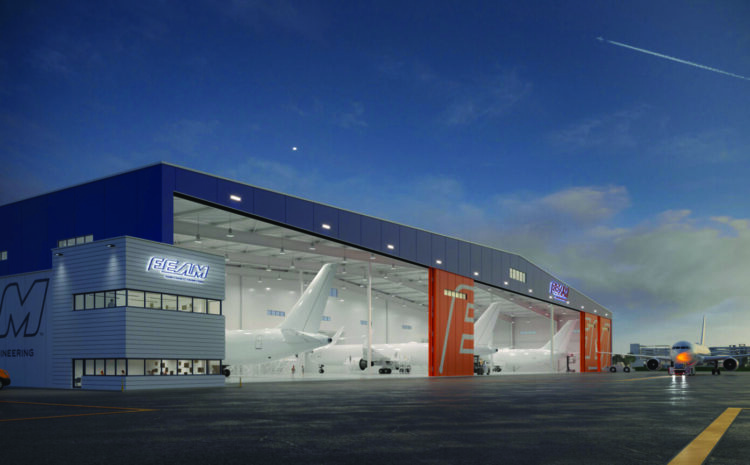
Atlas Air, and its subsidiaries, are major contractors for DHL and Amazon. The company established its 103,000-square-foot, $34 million operations center adjacent to CVG’s campus to support existing business and future growth. An aircraft maintenance hangar developed by Lynxs for FEAM Aero opened in 2020 to service wide-body aircraft. That company broke ground on its second hangar November of this year. All this cargo activity is taking place on the south end of the campus.
“General cargo activity is seeing an increase as well,” notes McGraw. “A new general use cargo facility was built by Aeroterm in 2019 on the north end of the campus with FedEx as the anchor tenant. We’ve identified areas for additional growth and expansion for our partners as well as development of more MRO types of hangars.”
Transportation capabilities within our region that are attractive to land-based L&D companies include the country’s largest inland port, Class 1 railway, highway transportation and two Foreign Trade Zones (46 and 47).
“Greater Cincinnati is a vital part of domestic logistics,” says Kerry Byrne, president of Union Township-headquartered Total Quality Logistics (TQL), the second largest freight brokerage firm in North America. “The region has key infrastructure, providers and, crucially, is within a day’s drive of a significant portion of the U.S. population. For TQL, we were founded here in 1997 and have grown our Greater Cincy team to over 3,000 people. We’re excited to help continue grow the reputation of the region as a logistics powerhouse.”
The company is on the move, and not just on our region’s interstates. TQL was featured in projects on both sides of the river, committing to expansion of 1,000 new jobs in southwest Ohio and another 125 in northern Kentucky.
If you spend any amount of time on the highways and interstates in the Tristate, you’ve probably noticed the many warehouse and distribution centers along the way—not to mention the trucks and commercial carriers on the road itself. Those are but the outward manifestations of a much larger industry cluster, according to Lee Crume, CEO of the Northern Kentucky Tri-County Economic Development Corporation (Tri-ED) that serves Kentucky’s Boone, Campbell and Kenton counties. According to the organization’s data from JobsEQ, there are approximately 36,000 people currently employed in the supply chain/transportation & logistics sector in Northern Kentucky.

“But you really have to decide what the industry is to get a true handle on its economic impact,” says Crume. “It is most visible to people in the form of the distribution and warehouse facilities and the trucks that you see on our interstates—that is the visible face of the industry.”
But the industry actual goes much deeper and has tendrils that impact the entire region’s economy.
“We really focus on what is behind the industry,” says Crume. “That includes not only CVG and companies like DHL and Atlas, but companies like FEAM Aero, the company that does the maintenance and repairs to keep those planes in the air.”
While it broke ground in November, the F&E Aircraft Maintenance (FEAM Aero) three-bay hangar at CVG, is expected to be completed at the end of 2023. The $40 million plus investment is expected to create nearly 250 new positions.
“But it’s also companies like Advanced Handling Systems that are making the systems and robotics that are working in logistics and distribution,” notes Crume.
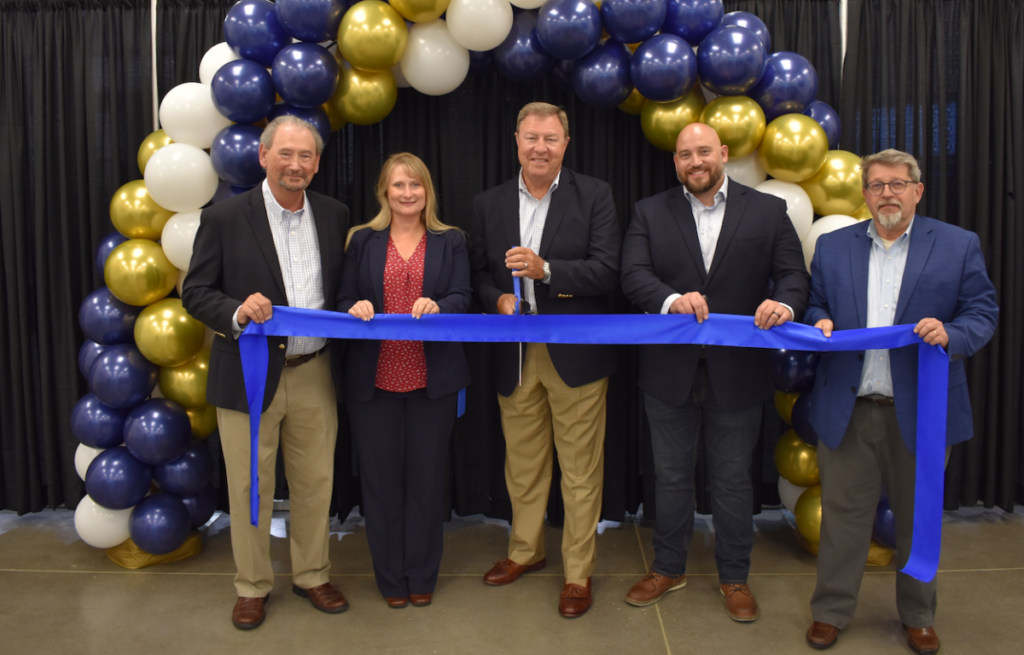
Hy-Tek Material Handling and Advanced Handling Systems celebrated the grand opening of its new innovation center in Erlanger earlier this summer, a half-million-dollar investment that added more than 35 new, high-wage jobs.
The L&D industry also impacts the consumer packaged goods industry, where companies are developing products and new innovations that are going into supply chain service.
“So you have to begin thinking about supply chain management and support services, which is much more than those buildings and trucks you see on the interstates,” adds Crume.
When it comes to growth, the L&D industry obviously supports much more employment than what you see on the surface. The cross pollination of L&D with other industry clusters is very important to our overall regional economy.
“It leads us to something that we as a community should start talking about, and by community I mean all of Northern Kentucky and the Cincinnati area,” says Crume. “We have gotten to a place where we are using just about as much available labor that we can reasonably use. If we are going to have our economy continue to expand, we’re going to need more people.
“The person who repairs the planes at FEAM Aero or flies the planes at Atlas is a very different person than the one who is loading a cage at Amazon or DHL,” Says Crume. “They are all very different skill sets. It’s up to us as a business community to think about how we can create more growth with the people who are here. The reality is that [those skill sets] are all important to our economy.”
The Cincinnati/Northern Kentucky region is already well positioned to address those varied skillset needs.
“Our region also lies at the intersection of technology and manufacturing in support of warehouse operations,” says Lauterbach. “Companies such as Trew and Honeywell continue to revolutionize automated material-handling solutions.
“Those two organizations, as well as those in the L&D industry, are supported by an educational foundation that includes both higher education, which produces more than 7,100 STEM graduates annually, and a robust technical school system to provide the workforce.
“The region’s ecosystem also supports innovation and collaboration within the industry,” adds Lauterbach. “From the Kroger/Ocado partnership that increases the delivery efficiency of Kroger’s goods to 80 Acres, which revolutionized indoor farming and created a technology platform to track plants from seed to store, the Cincinnati region is a national leader in L&D innovation.”
