


Get back in shape this spring and summer—gradually
Did you spend winter on the couch? Or, if you are active, did you take an extended time off from regular exercise during the cold weather?
Are you ready to get back to a healthy, active routine?
Warm weather in spring and summer attracts us outside and motivates us to start melting off some of those pounds gained since fall. The problem? After months of inactivity or infrequent exercise, many people want to dive into their regular routines. Instead, experts say, they need to slowly start a workout program to avoid injury.
“In the spring, once they get outside, there’s a high prevalence of overuse-type injuries, where they’re asking a lot from their bodies,” Dr. Peter Cha, an orthopedic surgeon, says.
Cha, also president of Beacon Orthopaedics & Sports Medicine in Cincinnati, adds, “The general rule is that you should increase 10% a week. So if you are going into a marathon-running program, or from couch to 5K, and you start out at a low increment—say, 1 mile. It’s very important to do a slow increase the next week, to 1.1 miles. And have a very graded progression and give yourself recovery days to let your body heal. If you make that your regimen, it’s very rare to have overuse-type injuries.”
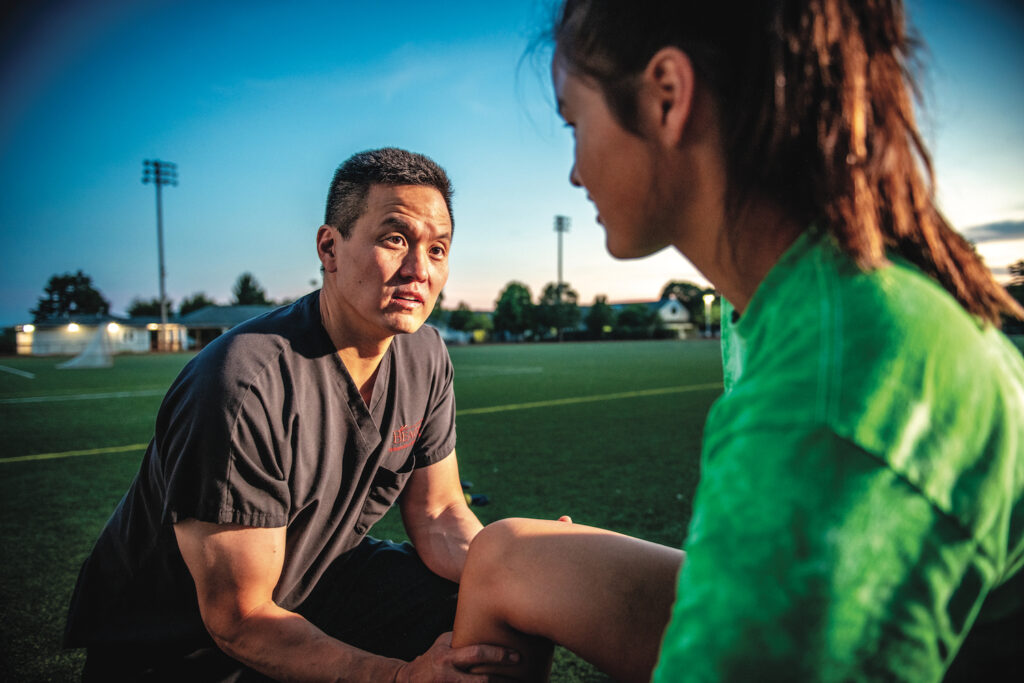
He also notes that “the younger you are, the more resilient your body is, and you can certainly push that protocol more aggressively, so it is very individualized, but the 10% a week is the protocol that we as physicians abide by.”
The same goes for weight-lifting or other muscle-building and toning exercise, Cha says.
“The road to failure occurs because you don’t give your muscles enough recovery time,” he says. “There’s lactic-acid buildup where you end up getting weakness within the tendons, the bone interface or the musculo-tendon junction interface, so it’s really about putting yourself through the workout but giving yourself the rest-and-recovery days.”
When you experience a lot of soreness after a long period off, it takes the body four or five days to absorb all of that lactic acid, he says. “As you get more in shape, your body resiliency adapts, and you can go on an everyday type program per muscle group.”
Cross-training also is critical in avoiding injury, Cha says. Even competitive marathon runners don’t just hit the pavement and run.
“They need to work on their flexibility, they need to work on their core strength, they need to build muscle mass, so they are not just running, but they are these cross-training athletes. You can’t be so specialized and do your one repetitive activity all the time. That’s a recipe for overuse, injury and inability to recover.”
Children in sports have the best bodies for activity if they, too, follow certain regimens, and when they do suffer an injury, they have the ability to bounce back much more quickly.
“If you break a bone as a child, your recovery might be three to six weeks,” Cha says. “If you break a bone as an adult, it’s a minimum of three months.” The elasticity of the skeleton of an athletic child is much higher, whereas the skeleton of an older person is “more, quote, brittle.” Older people, in general, also have less muscle control.
Dr. Melanie Kennedy, pediatric sports medicine physician at Cincinnati Children’s Hospital Medical Center, sees mostly adolescent and teen patients, most who are involved in competitive athletics.

She, too, stresses the need to ramp up in warmer weather: “Going slow, gradually building up the volume is a big one, and making sure that they have a proper warm-up, 10 to 15 minutes, with dynamic stretching. Warm muscles are going to perform better than cold muscles.” Also allow at least one day of rest each week.
Kennedy is a proponent of cross-training, encouraging young athletes to not only run, but to use ellipticals, stationary bikes or just walk as they increase distance in track or soccer or swimming, for instance. She also says expanding activity by 10% to 15% a week is important to avoid overuse-type injuries. Another general rule is that children should not engage in sports activities more hours a week than their age—so a 12-year-old should not exceed 12 hours a week, she says.
She encourages athletes to train individually for a month ahead of their sports season so that they are increasing range of motion and flexibility, helping decrease the possibility of injury.
Shoulder and elbow injuries are especially common for boys in baseball and girls in softball. Kennedy says girls tend to be more at risk because of growth changes during puberty and because there are fewer pitchers on teams. She also says catchers face more risk of injuries because they are throwing every pitch back to the pitcher and sometimes trying to throw out runners stealing bases.
ACL tears are more prevalent in soccer for both boys and girls, as well as in gymnastics and dance.
Sports seasons tend to dictate the patients Kennedy and others at Children’s are most likely to see—in the fall, football players; in winter, basketball players, wrestlers and swimmers; in the spring, it’s baseball, softball, track and soccer; throughout the year, it’s gymnasts.
Childhood obesity is a problem in the Cincinnati area, and Kennedy and her colleagues participate in programs at schools to encourage more exercise and better nutrition. She also works as an athletic trainer with three Cincinnati Public Schools high school teams.
“We see that trickle in, even in athletes,” she says, adding that working with overweight children either in an injury-rehabilitation situation or trying to get them to become more active requires some creativity. “Find a way to make it fun. Don’t force them into a sport that they don’t find enjoyable. Make it some sort of a game. If they’re doing their rehab exercises for a foot or ankle strength, have them pick up marbles and try to put them in a cup. Meet them on the level where they’re at.”
A four-pound increase in weight is a 10% increase in the load on a joint, she says. “We look for something to keep them motivated and keep them moving so that they’re not just stationary in front of screens.”
Overtraining syndrome is another area that has become more prevalent, she says. Young athletes get involved in so many things that they get burned out or stressed to the point that it affects their performance. It has been happening in Olympic and world competitions.
“There are so many things involving other specialists, not just sports medicine,” Kennedy says. “Psychology and physical therapy. Those are challenging cases. When they get back to their optimum levels, it’s very gratifying.”
Beacon Orthopaedics’ average patient age is someone in their 40s, Cha says, noting that he treats patients from 2 to 102.
Cha, 50, ran 5 miles a day in his 30s, and still tries to run 2 or 3 miles once or twice a week. He also works out on an elliptical machine or bike. “You reach a threshold at 40 to 50 where you need to refocus on strength training,” and that can be weights, yoga, Pilates or whatever works for you.
“The psychology of exercise is interesting,” he says. Although it can be a lot harder as you age and your body is deteriorating, Cha says, “there’s a lot more excuses to not work out over time because of having children, or your knee is hurting and you say, ‘I’m not going to work out today.’ You don’t have those excuses when you’re 25 years old.”
The body’s limits change as we age. “You can’t run 5 miles a day for 50 years. Your body will fail,” Cha says. “You have to evolve out of that. You have to focus on stretching, and be more conscious of your diet as you age, as well.”
Bottom line for exercise: Get psyched. Develop a plan. Start slowly. Ramp up. And limit those excuses.
