


Despite pandemic challenges, our parks system is among the best in the nation
Usage of Cincinnati Parks has increased during the pandemic despite staff shortages.
Maintaining and operating one of the best parks systems in the nation in the midst of a global pandemic is not exactly what you would call a walk in the park.
But that’s exactly what our city’s park system was able to do.
Offering residents more than 5,000 acres of parklands, Cincinnati Parks recently was ranked No. 8 in the nation among more than 100 of our nation’s largest cities by the Trust for Public Land, which based its evaluation on both access and quality.
Today, Cincinnati Parks consists of five regional parks, 70 neighborhood parks, 34 natural areas, five neighborhood nature centers, 30 sites managed by the Cincinnati Recreation Commission, five parkways, 16 scenic overlooks, two arboretums and 65 miles of hiking and bridle trails. The Trust for Public Land’s evaluation showed that 87% of Cincinnati’s population resides within a 10-minute walk of a park.
But like all organizations, companies and individuals, Cincinnati Parks was significantly impacted by COVID-19.
“Thanks to tremendous support from the mayor, city manager and city council and Board of Park Commissioners, we were proud to be able to keep our parks and trails open for the general public to enjoy throughout the pandemic,” says Rocky Merz, division manager of Communications, Engagement and Tourism for the parks. “They provided a critical place for people to escape and recreate during a very stressful time when most other places were closed.”
Managing the large numbers of visitors in a safe way and avoiding large crowds was a challenge. At the same time, staffing levels were reduced for three months due to the financial losses experienced because of the pandemic. This meant that even though many new safety and cleaning procedures were in place, the parks had less staff available.
“We prioritized tasks and did the best we could to keep our spaces safe and welcoming for our visitors,” says Merz. “The pandemic conditions have really shown a spotlight on our parks spaces and the value they provide our residents.
“This is consistent with our history as well. From its inception, our parks system was always envisioned as providing places all residents could go to find a clean escape.”
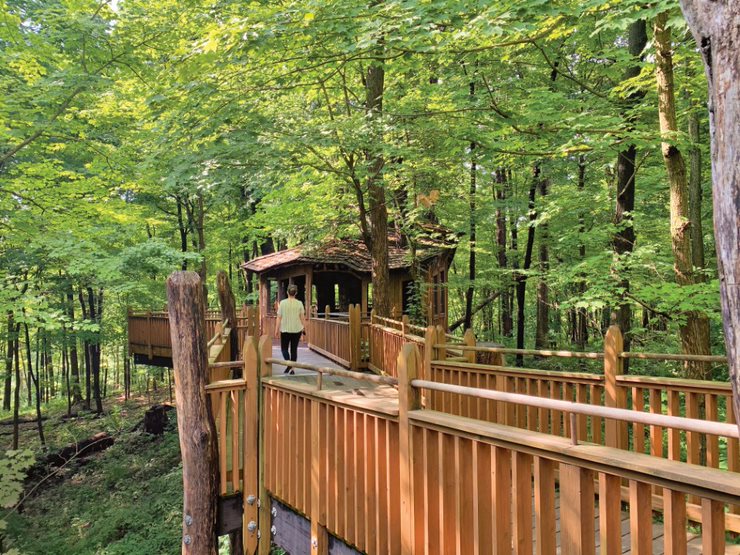
While longtime residents are well acquainted with what the Cincinnati Parks offer, newcomers and visitors to the city fall in love almost immediately.
“I first visited Cincinnati in 2017, and while visiting I made my way to many Cincinnati Parks and fell in love with the system and its history,” says Kara Kish, who is now director of the Cincinnati Parks. “In 2019 I had the opportunity to join the parks, beginning a journey to hopefully make an impact at Cincinnati Parks and in the community.”
Kish was named director of the system a scant two months before the pandemic hit.
“Experiencing and leading an organization through a pandemic was not what I had in mind for year one,” says Kish. “However, this was the challenge at hand. Under leadership from city administration and alongside the Board of Park Commissioners and leadership team, we were able to meet the essential needs of the community.
“I had a brief amount of time with the city prior to the pandemic, which allowed for some relationships to be built, which were critical throughout the pandemic.”
The city’s robust and thriving system of parks dates back to the 1860s with the development of Washington, Hopkins, Eden and Piatt parks.
“As a downtown resident, Washington Park not only serves as my backyard, but I find it to be a place which at any given moment, fully encompasses the entire community of Cincinnati,” says Kish. “Washington Park was the first Cincinnati park I ever visited and remains an incredibly special place in my daily life.”
In 1907, landscape architect George Kessler created Cincinnati’s first park master plan to promote green oases within the environment created by the Industrial Revolution. As a result, many have described Cincinnati as a city within a park.
Needless to say, the civic pride created by the parks system has led to plenty of direct community involvement.
“Volunteers are absolutely critical to what we do and how we do it,” says Merz. “We wouldn’t be able to care for our sites and operate the community programming we offer without their selfless efforts. In fact, last year despite the pandemic, we were fortunate to have 2,800 individuals volunteer 33,600 hours for a total economic value of $800,000.
“We are often contacted by high school and college programs or students working on projects,” Merz adds. “In fact, right now, our youth employment program, called the Green Team, is kicking off.”
Through this program, youth through the Project Groundwork Ohio River Valley have the opportunity to work in paid positions alongside park staff to gain valuable skills and experience as they execute all sorts of green projects.
But there are still challenges ahead. Just as everything seemed to close down all at once, the parks system is now dealing with it all opening back up.
“For us, this really impacts our public events schedule,” says Merz. “Coming off a year with hardly any planned events in our parks, we are now bursting at the seams with community organizations and partners who want to get events and programming on the books. This creates a challenge, but it is one we are excited about because it allows us to continue our work in collaboration with the community, which at its core is what our park spaces are all about.
“Our challenge, and this is a challenge we are energized and excited to tackle, is to continue to improve and care for all of these spaces, ensuring they are up to the standards our residents and visitors expect.”
