


Butler Tech’s certification programs help fill the workforce pipeline
As one of the largest career technical schools in our state, it’s certainly no secret that Butler Tech plays a key role in meeting the technical education and training needs of students throughout our region. What a lot of people don’t realize is that the school also plays a key in our region’s economic development.
Through its Butler Tech Adult Education program, students can receive the training necessary to change their lives with a new rewarding career in 11 months or less. Sometimes, that might mean as little as one month of study.
However, the four education pathways at the two Butler Tech campuses that offer Adult Education also target specific professions, often with jobs waiting once a student completes the course and is either credentialed or certified.
“Our courses are designed to give students the opportunity to get an industry credential in less than a year,” says Nick Linberg, executive director of strategic planning at Butler Tech, who oversees the Adult Education programs. “That means you can upskill and get a higher paying job. You go straight into the workforce, and the best part is, you usually have employers waiting for you.”
Many people today simply don’t want to take (and more importantly pay for) liberal arts classes. Instead, they want to learn a skill and go directly into the workforce as fast as possible with the least amount of debt. Similarly, employers realize that a degree is not always a requirement for a skilled trade, says Linberg.
“If you are trained and show competency through a credential or certificate that is all they really need,” says Linberg. “And there are plenty of opportunities. You see hiring signs all over the place.”
Butler Tech offers four different pathways as a part of its Adult Education programs. These include health care, industry technology (business and industry), public safety and transportation. Within each of those pathways are curricula for specific professions. For instance, the health care pathway has five different courses, which include practical nursing, medical assisting, medical billing and coding, phlebotomy and state-tested nursing aide (STNA) certification.
“And within the health care pathway, we are partnering with the five major health care networks in our area that recruit and hire out of our programs,” Linberg points out.
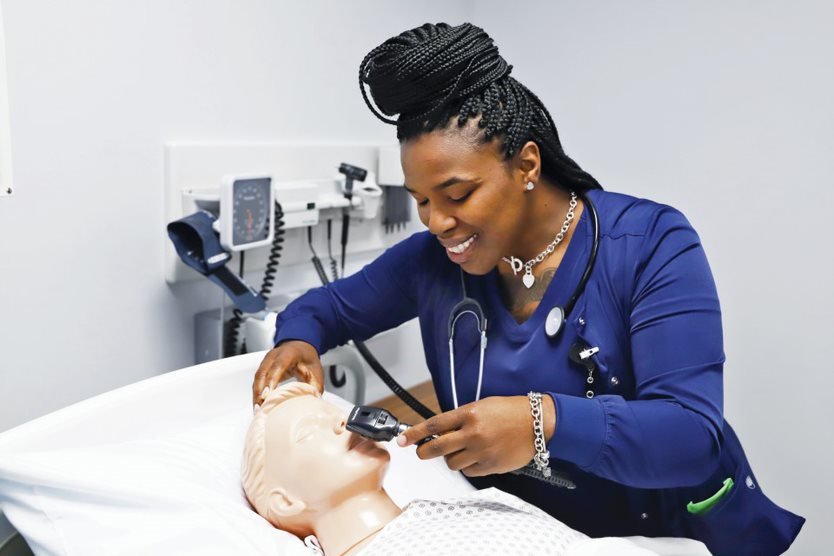
The Adult Education program can also be used as a steppingstone, Linberg says. A student might graduate the health care pathway as an LPN (Licensed Practical Nurse), but go on to achieve a two-year associate’s degree in nursing or even a four-year degree as an RN, if they want to go back to school.
“So it is a way of continuing on a career path while you’re being educated, while at the same time you can continue to work and provide income,” Linberg adds.
The same is true of other career pathways offered at Butler Tech. Industrial Technology offers four different programs, which include heating, ventilation, air conditioning and refrigeration (HVAC), industrial welding, industrial maintenance technology and computer aided design.
The public safety pathway includes nine different programs, which help train students for positions as police officers, EMTs, fire rescue personnel, paramedics, private security positions, other law enforcement positions, private security firearms certification and requalification and firefighters at Level 1 and 2. There is even a personal enrichment pathway within Adult Education that offers certification in computer courses and other professional skills. The transportation pathway offers training to get your CDL (commercial driver’s license).
So how does Butler Tech come up with these specific programs? In a word: partnering.
“We have all kinds of partners in economic development as well as companies who are looking to hire,” Linberg explains.
In addition to the major health care providers mentioned earlier, partnerships include economic development organizations like REDI Cincinnati, JobsOhio and Ohio Means Jobs. It also includes partnerships with existing companies looking to fill the workforce pipeline.
“Our programs basically mirror business needs,” says Linberg. “For instance, we have a fulfillment center close to us, so we’re going to offer a mechatronic program so students can come in and work with robots. We have another program with an energy company that will help them with staffing and an aluminum extruding company that needs more CNC workers—so we’re adding classes that train people to be CNC operators.”
Butler Tech also has business advisory committees that help the school develop education programs based on what local business needs are.
“And we ask them if they think we should change our curricula, or whether or not they have new positions that they need to fill,” adds Linberg. “Here in the Miami Valley, we also have economic development groups that are pulling in companies with specific workforce needs and we work closely with them as well.”
Which includes local chambers of commerce, like those in Hamilton, Middleton, Trenton, Monroe, Fairfield, Liberty and West Chester.
Obviously Adult Education programs are ideal for finding work while going to school, which makes them perfect for working heads of households or single parents. The programs are also very diverse and inclusive, Linberg notes.
“And we are very proud of that at Butler Tech,” says Linberg. “In fact, my highest completion rate is with people of color, which is over 85%. A lot of community colleges and regional four-year colleges have nowhere near that completion rate.
“And with single parents, which is another of the demographics we track closely, we had an 84.7% completion rate.
“I give them kudos because I don’t know if I could go to school and support a family at the same time. And I am very proud of my staff because we are so diverse and inclusive. We want to make sure all our students are successful. And we want to make sure we welcome everyone to our programs.”
Adult Education classes are held at Butler Tech’s campuses in LeSourdsville and Liberty Township. The program is approved and operated in cooperation with the Ohio Department of Higher Education and is accredited by the Council on Occupational Education.
