

Cincinnati and SW Ohio are playing a key role in home delivery
Look, up in the sky! It’s a bird. It’s a plane. It’s certainly not superman, but it just may be our next superhero and the future of home delivery services.
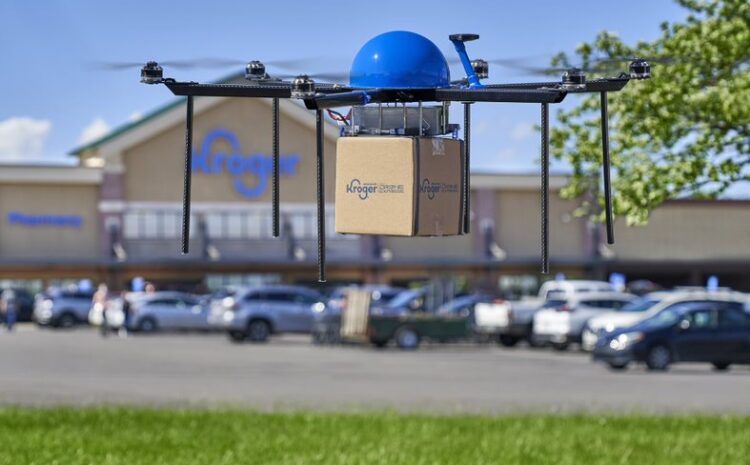
That future is currently being tested by Kroger right here in Centerville.
In increasing numbers, major retailers across the country are exploring the use of drones as a part of home delivery systems. And while there are many hurdles that can’t be overcome with a single bound, scientists, engineers and retailers are addressing the technological, legal and societal issues facing the advancement of drone usage. How fitting that our area, considered the “Birthplace of Aviation,” should play such a critical role in the future of this nascent industry.
Today, there are well over 339,000 commercial drones registered in the United States, performing myriad services for a wide range of industries, including real estate marketing for both residential and commercial applications; construction project monitoring; structural inspections of buildings, power lines and oil and gas pipelines; and precision agriculture among many more. The use of drones for commercial applications is limited only by your imagination. Think of any industry where you might need an “eye in the sky.”
“Real estate is where most people get their start with their first drone,” says Ron Kloska, an independent pilot whose company The Kentucky Drone Guy serves the Covington and Cincinnati areas. “Today, I’m also getting work for construction monitoring and property management purposes.”
Technology is also opening doors in other industries for independent operators. Alex Fead, who runs the local John Henry Drone Works, sees a future where independent operators may need to specialize in specific industries.
“The camera quality is improving,” he says, “so farming is another growth area on the horizon—precision farming for pesticide applications—using cameras to identify crop issues. There are a lot of applications, and many people are trying to figure out what areas they should specialize in.”
So the industry is growing in terms of both independent commercial pilots and national drone services companies.
“I haven’t seen any recent reports, but I would estimate the industry is growing anywhere from 25 to 50% per year, depending on the client sector,” says Jeff Crist, managing partner of Nadar Aerial Imaging aka Nadar Drone Services. Nadar Drone is one of the leading drone services companies in the nation. While headquartered in Seattle, it has pilots flying all over the country, including the Greater Cincinnati area.
“In the last two years, it has really started to accelerate as different industries become more aware of all the potential applications of drone usage,” says Crist. “There’s kind of a snowball effect. Once a company starts to use drones to do something in their line of business, their competitors eventually find out and then you start to see a surge in that industry.
“In the beginning, real estate advertising was the most popular drone service along with construction project monitoring. Now, we’re seeing an acceleration in other industries such as property management and others.”
Earlier this year, the Kroger Company took a giant leap forward in the use of drones, developing a pilot program (no pun intended) that would offer grocery delivery via autonomous drones, expanding the retailer’s seamless ecosystem and providing its customers with anything, anytime, anywhere. The program was developed in partnership with Drone Express, a division of TELEGRID Technologies.
The Drone Express technology allows package delivery to the location of a customer’s smartphone and not just to a street address. In addition to your home, you can have groceries delivered to the location of a picnic, sunscreen to a pool, or condiments to a backyard barbecue.
The program launched earlier this past summer on the weekend of July 4 with deliveries from the Kroger Marketplace on South Main Street in Centerville.
“Autonomous drones have unlimited potential to improve everyday life, and our technology opens the way to safe, secure, environmentally friendly deliveries for Kroger customers,” says Beth Flippo, chief technology officer of Drone Express, a company that manufactures drones in Monroe. “The possibilities for customers are endless—we can enable Kroger customers to send chicken soup to a sick friend or get fast delivery of olive oil if they run out while cooking dinner.”
By all accounts, the program has been a success.
“When we started this, we knew that drones couldn’t fly very far,” says Flippo. “So we knew we had to find a client with several locations and a lot of customers close around them.

“Kroger has multiple stores that are located in the center of the neighborhood. These locations can offer fast deliveries that are also cheap. It might have been easier to go to a small single grocery store to try this out but we knew the Kroger footprint would allow us to scale operations within current FAA regulations.”
Kroger has been happy with the initial results as well.
“We’ve been thrilled with our Drone Delivery service, and more importantly, so have our customers,” says Jenifer Moore, a spokesperson for Kroger. “Customers can shop more than 6,000 products, including everything from groceries to gift cards, and their order will be delivered within 60 minutes. We’ve received such a positive response from customers on the immediacy of our Drone Delivery service as they get the few items they need immediately, while saving a quick trip to visit us in-store.
“Also, we have extended our Free Delivery special offer and will continue to offer it to customers throughout the holidays.”
Kroger recently expanded its Drone Delivery radius from one mile to two, just in time for the holidays, so more of its customers could take advantage of the innovative service.
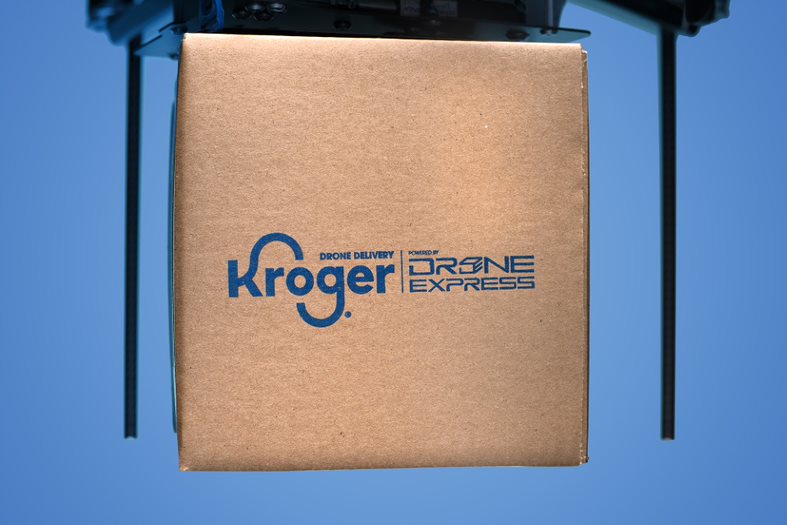
“This expansion was due to the overwhelming customer interest as we had over 500 Centerville customers sign up for our waitlist as they were just outside of our initial one-mile delivery radius” adds Moore.
For other retailers, drone delivery service may be in the more distant future, according to both independent pilots and drone services companies. Kudos to Kroger for exploiting what may be seen as an Achilles heel of its competitors.
Public demand for drone service is certainly here and has been accelerated by COVID, making this a perfect time to start the service. COVID has changed everyone’s mind about home delivery. In the past, you used to hear a lot of negative comments from the community about drones. But today, people understand that it is a contact-less delivery. It’s autonomous, fast and it’s eco-friendly.
While both Amazon and Wal-Mart are working on drone delivery, they simply do not have the footprint that Kroger does. Because of power supply and legal issues, drones can’t fly very far. So the ideal candidate needs to have customers within a close flight radius. Which means retailers like Kroger have a natural upper hand.
However, not everyone in the industry agrees that home delivery is practical—at least not yet.
“In my opinion, using drones for everyday deliveries is a little over-hyped,” says Crist. “There are just so many hurdles that you have to get over.
“Range is one of them with drones being limited by battery capacity. You also need a proper landing area and favorable weather conditions. Deliveries to rural areas, areas with obstructed landing areas, and during times of high winds or heavy precipitation will be problematic.”
There are also issues like potential accidents and society’s reaction to them, Crist points out.
“People are okay with planes flying overhead because most of the time they are flying at very high altitudes,” says Crist. “But as drone delivery becomes more popular, it will be interesting to see what the community response will be to having a lot of drones flying overhead at much lower altitudes than planes.”
The biggest benefit and earliest adoption of drone delivery, which has already happened to an extent, is for short distance emergency delivery of things that are not large and heavy, adds Crist.
“An excellent example of that might be the delivery of transplant organs between hospitals, or drugs or blood—things of that nature,” says Crist. “I really see drones being practical for emergency deliveries in urban areas.
“During the pandemic, as sort of a joke, a person in San Francisco used a drone to deliver a roll of toilet paper to a neighbor.”
The FAA is working with the industry to develop regulations and technologies to allow for drone delivery services. However, there may also be local laws to contend with. In most cities you can’t fly drones in city or county parks.
“So if there is a park in the flight line of where you are taking off and where you want to do a delivery, you might have to fly around the park, or have the city adjust its rules,” says Crist.

Ohio has one state-wide law concerning the use of drones in the state. This law created an aerospace and aviation technology committee. One of the committee’s duties is to research and develop aviation technology, including unmanned aerial vehicles. All drone pilots operating commercially in the state of Ohio are subject to the Federal Aviation Administration’s (FAA) Part 107 rules. (See sidebar Important Questions to Ask before Hiring A Drone Pilot or Operator.)
Cincinnati Parks has a rule that bans drones, except with the written permission of the park board and within such areas that may be designated by the park board. A Butler County MetroParks rule bans drones except when operation is within an area designated by the park board or with a special permit. Hamilton County bans drones in any of its Great Parks, except when the operator has obtained written permission.
Technological and regulatory obstacles may be an impediment, but will certainly not de-rail progress in the long term.
“Years ago, we went from brick-and-mortar stores to people buying goods and services online via computer, but that didn’t happen overnight,” says Crist, who also has a background in e-commerce development.
“It took five to 10 years for online shopping to really start taking off. I would say that widespread drone delivery, where you have companies like UPS, FedEx and Amazon using drones to make deliveries could be as much as 10 years out.
“It would mean that every location that wanted drone delivery may need a special landing pad, so the drone knows exactly where to land. In addition to the technological challenges, there are so many regulatory hurdles that need to be addressed.”
For instance, the FAA has issued Part 135 air carrier certificates to only a very small number of companies, which allows them to fly drones beyond line of sight.
“I expect the FAA to continue to move slowly and carefully, [when it comes to drone delivery], adds Crist. “But it is definitely a fascinating subject—I just don’t see it happening on any large scale very soon.”
Drones: Past, Present and a Promising Future
Drones, or unmanned aerial vehicles, have been around for centuries in one form or another, with unmanned incendiary balloons being used by the Austrian forces in their assault in Venice in 1849—a usage that ended up in a spectacular failure once the wind changed direction. There are even those who argue that the Chinese used balloon drones much, much earlier.
Drone warfare began in 1982, with Israel using UAVs to help it wipe out a Syrian fleet. The first modern military drone strike happened in 2002, targeting someone suspected of being Osama bin Laden. That certainly wasn’t his lucky day.
The first quadcopters (or popular drones as we know them today) appeared in 2006 with the release of models from a German company. This really marked the beginning of non-military commercial use of drones for business.
At first, drones were thought of as a means of spying on neighbors or people sunbathing in backyards. But in 2013, Jeff Bezos announced that Amazon was thinking of using drones as a delivery system.
Since then, drones have really taken off, with the Federal Aviation Administration (FAA) issuing 1,000 drone permits in 2015, a number that tripled the following year. Today the FAA estimates that there are 867,590 drones registered in the United States. Of those, there are 339,098 drones designated for commercial use.
Unfortunately, drones still have something of a mixed bag when it comes to their reputation. Earlier this year, two men from East Cleveland were indicted on multiple felony drug charges, including illegal conveyance, drug trafficking and drug possession for dropping contraband, including drugs and cellphones, into the prison yard of the Warren Correctional Institution. However, drones were also used to aid in the search for a missing 73-year-old man, after his boat capsized on the Great Miami River. This year, the Richland County Sherriff’s Office received funding to acquire a drone, which will offer an “eye in the sky.” The unit is being described as “an indispensable tool” in helping law enforcement officer do their jobs.
So what does the future hold?
In addition to the drone delivery services outlined in our feature, drones may soon be used extensively in unmanned urban transportation. Joby Aviation, a California aerospace company, is developing an all-electric vertical takeoff and landing aircraft, which it intends to operate as a fast, quiet and affordable air taxi service as early as 2023. The zero emissions aircraft, which can transport four passengers and a pilot, can fly up to 150 miles on a single charge and can cruise at 200 mph. It is designed to help reduce urban congestion and accelerate the shift to sustainable modes of transit.
Indeed, Joby recently announced that Uber Technologies has agreed to invest a further $75 million as a part of a broader transaction involving the acquisition of Uber Elevate by Joby and an expanded partnership between the two companies.
Under terms of the deal, Joby Aviation will acquire Uber Elevate with the two parent companies agreeing to integrate their respective services into each other’s apps, enabling seamless integration between ground and air travel for future customers.
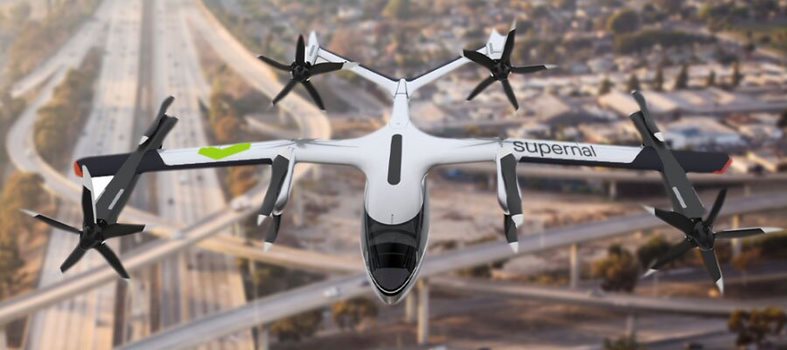
Not to be outdone, automaker Hyundai just launched a new company called Supernal that will be focused on drone taxis. The company started as an internal project at Hyundai called the Urban Air Mobility Division. It has now moved past the testing phase and is ready to stand on its own. Supernal will be based in the U.S. The company has ambitious goals—it’s already shared plans to begin the certification process for its S-A1 electric taxi drone by 2024, and to conduct its first commercial flight by 2028.
The company also is developing a family of electric air vehicles and convening public and private stakeholders to responsibly shape the emerging Advanced Air Mobility (AAM) industry.
“In adding a new dimension to mobility, we are on a mission to transform how people and society move, connect, and live,” says Jaiwon Shin, CEO of Supernal and president, of Hyundai Motor Group. “We have bold ambitions at Supernal but being first to market is not one of them. We are working to build the right product and the right integrated market, and we will leverage Hyundai Motor Group’s scaled manufacturing expertise to ensure AAM reaches the right price point and is accessible to the masses.”
Courtesy of Supernal, Jeff Crist
Important Question to Ask before Hiring a Drone Pilot or Operator
So you’re looking for a drone company to work with. How do you choose the right one for you? There’s a wide variety of both applications and skill sets in the drone services industry. Not making the right choice could mean issues with service delivery and work-product quality. In addition, making the wrong choice could also expose you to legal repercussions.
Are you hiring a drone pilot or a drone services company?
It is important to make a distinction between a Drone Pilot and a Drone Service Company. The former typically has limited expertise outside flying drones and capturing photos and video, in many cases, in their spare time. The latter has multiple staff members with expertise in various areas.
Accidents happen. Are they properly insured?
Typically, Commercial General Liability (CGL) insurance policies do not cover aviation-related claims. The chances of an accident are low, but you can also say that for car accidents. Is it a good idea to drive without car insurance? Of course not. You should make sure the company you are dealing has an adequate Drone Liability Insurance Policy that covers damage to property and personal injury. In the event of an accident, it is very common for legal action to be taken not just against the Drone Company but also the client of the Drone Company. In some cases, the client may ask the Drone Company to provide an insurance certificate in which the client is also named on the certificate along with the Drone Company.
Are they following FAA drone regulations?
Drones cannot be flown for commercial purposes in controlled airspace without prior approval from the Federal Aviation Administration (FAA). Doing so could negate the pilot’s insurance coverage and put both them and their client at legal risk. What is controlled airspace? It’s a bit complicated, but in general, you cannot fly a drone for commercial purposes within five miles of most airports without FAA authorization for that specific location.
A pilot cannot get a “blanket” authorization to fly anywhere they like within a large area that is within five miles of an airport. There are also many other rules such as no flying over moving vehicles, flying over people that are not part of the job-site personnel, and flying at night. These all require an FAA Waiver.
In addition, cities, counties and states are increasingly implementing their own local ordinances which also should be followed. Is the drone company you are considering aware of and keeping up with all the local rules?
Both authorizations and waivers can take up to 120 days to process by the FAA. It is a huge red flag when any pilot fails to disclose the location is in controlled airspace or says it’s OK for them to fly without authorization. Ask the pilot for a copy of their FAA Authorization.
Rules for drone flight are in a constant state of flux. Always check with the FAA to see the most recent updates on regulations.
Source: Nadar Aerial Imaging aka Nadar Drone Services
