
In our 15th annual Rating the Burbs feature, we look at our local communities to see how they stack up against one another. Where did your community fall in this year’s list?
Compiled by Bill Ferguson Jr.
Full Print Feature
1 Terrace Park
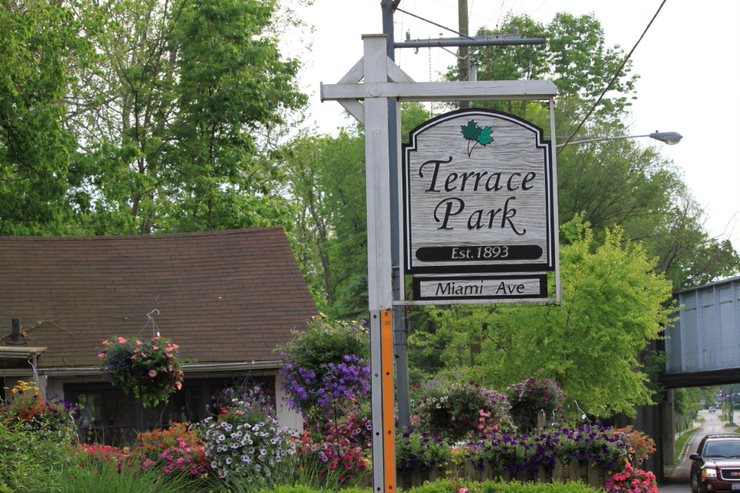
Terrace Park repeats its 2020 No. 1 top spot in this year’s “Rating the Burbs.” The village of almost 2,300 residents scored highly across several categories. Terrace Park was No. 1 in low crime—it had no incidents in the eight FBI Uniform Crime Reporting categories. The community was fourth in homeownership (95.4%) and sits in one of the highest-rated school districts in the area (Mariemont City School District). With tree-lined streets, the quiet, mostly residential village offers plenty of fun at the Swim & Tennis Club, established in 1956; the Terrace Park Country Club (1910); and the Terrace Park Garden Club (1920), as well as traditions such as Memorial Day and Labor Day parades. The village sits along the last stretch of Wooster Pike (U.S. 50) in Hamilton County before entering Milford.
2 Madeira
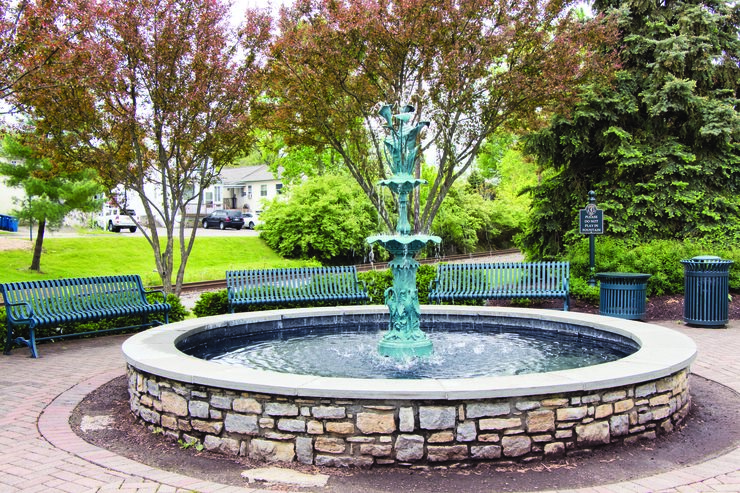
Madeira also is a 2020 repeat, at No. 2. It’s familiar territory, with the city of 9,245 residents finishing either first or second every year since 2010, except in 2015, when it was No. 3. A strong public education system (Madeira City School District), relatively low crime and a relatively low average commute-to-work time lifted Madeira to its high ranking. More than 87% of homes were owner-occupied in a community that is zoned more than 90% residential. Sitting next door to Kenwood Towne Centre, the 3.4-square-mile city is conveniently located off Interstate 71 about 12 miles from downtown Cincinnati. For recreation, residents can enjoy three parks: Sellman Park, McDonald Commons Park and Nelle V. Hosbrook Bird Sanctuary.
3 Springboro
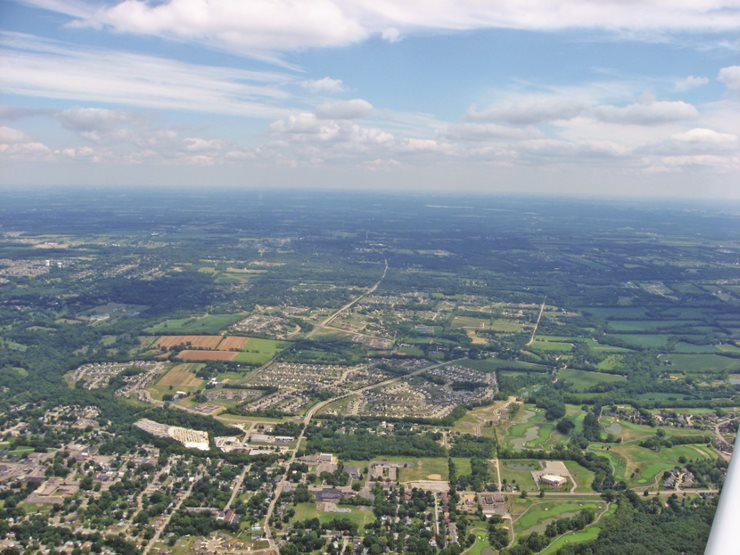
This historic city located between Cincinnati and Dayton straddles two counties: Warren and a small piece in Montgomery. With low crime and a good education system, Springboro makes its first top 10 appearance since 2018. The city of 18,931 residents was founded as a village in 1815 by Jonathan Wright, a Quaker, and became a city in 1987. Nine city recreational areas—Clearwater Park, Community Park, E. Milo Beck, Gardner Park, Hazel Woods Park, Kacie Jane Park, Mills Park, North Park and Rotary Park—provide access to many sports activities, picnic facilities, shelters and walking trails. The city experienced a 47% increase in its median home-sale price last year, to $334,900, from five years earlier.
4 Wyoming
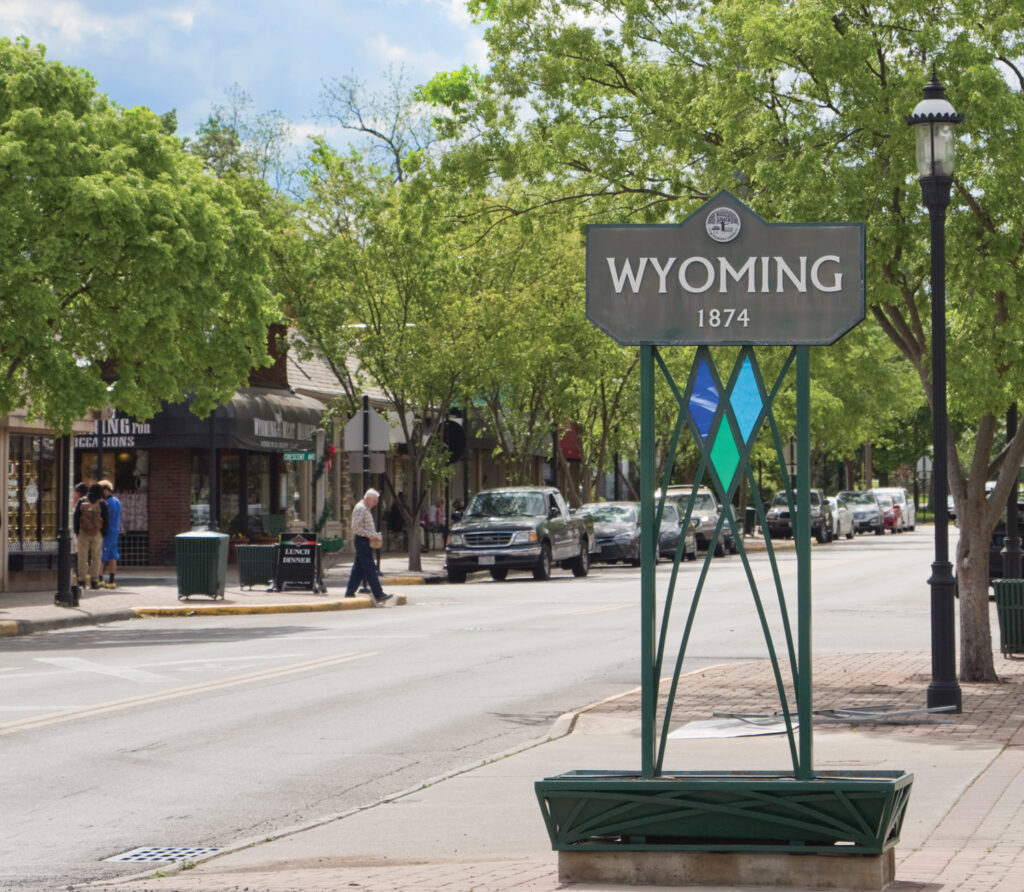
This city, which regularly appears in the Top 20, lands at No. 4 with its highly rated Wyoming City Schools (No. 3 this year), a high homeownership rate of 87.8% and a big increase in its median home-sale price in 2020, to $389,000, up 53%. Wyoming is located in the Mill Creek Valley, which, according to the city’s website, “provided a route from the Ohio River to points north since Native American times.” Growth occurred in the community with the completion of the Miami & Erie Canal in in the late 1820s in nearby Lockland; many Lockland factory owners built their homes in Wyoming. When the Cincinnati, Hamilton and Dayton Railroad was put into service in 1851, Wyoming began to see development accelerate. In 1874, Wyoming officially became a village with 600 residents; it became a city in 1949, and today has 8,562 residents in its 2.87 square miles.
5 The Village of Indian Hill
The Village of Indian Hill makes its ninth top 10 appearance since 2010. With an education system (Indian Hill Exempted Village School District) ranking No. 1 this year, a top homeownership rate (98.7%) and low crime, the city is an attractive place for residents. Indian Hill was incorporated in 1941. It became a statutorily required city when its population reached 5,000 in the 1960s, but it changed its official name to “City of The Village of Indian Hill” and maintains its rural feel and charm. Indian Hill, with 5,786 residents, is zoned 100% residential in almost 20 square miles. Julius Fleischmann made the first gift of land, 38 acres, to Indian Hill in 1946, its website says, and that began a commitment to greenspace. Residents can find plenty of exercise, fun and relaxation opportunities at 10 parks and recreation areas, including a bird sanctuary and 75 miles of horse-riding trails.
6 Blue Ash
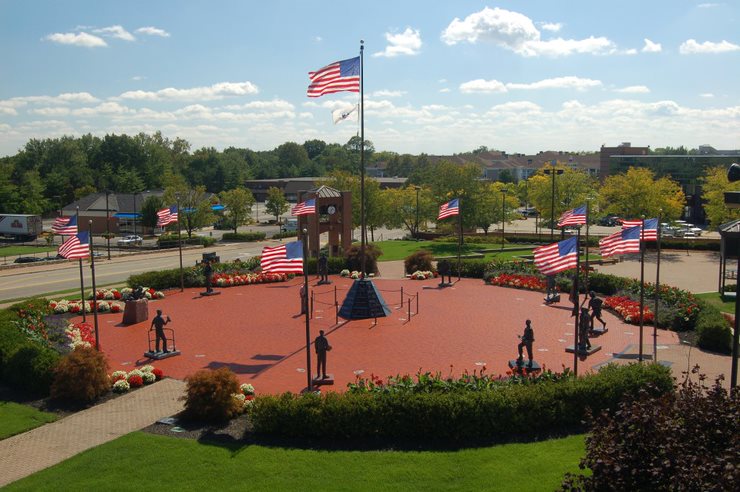
Blue Ash ranks No. 6 this year, offering residents a relatively short commute time (20.1 minutes on average), good schools (Sycamore Community School District) and a big gain in the median home-sale price in 2020—to $371,000, up 70.5%, from 2015. The city also offers 280 acres of parks and recreation thanks to its many parks and attractions, such as Bicentennial Veterans Park, Blue Ash Golf Course, Blue Ash Recreation Center, Blue Ash Sports Center, Cooper Creek Event Center, Hunt Park, Nature Park, Oakwood Park, Summit Park, Towne Square and White Oak Park. As home to about 2,300 businesses, Blue Ash’s population triples in the daytime hours to more than 40,000. With land use split almost evenly at about 35% residential, 35% business and 30% public, the 7.7-square-mile city is considered a model community of its size as it juggles all its varied interests.
7 Oxford Township (Butler County)
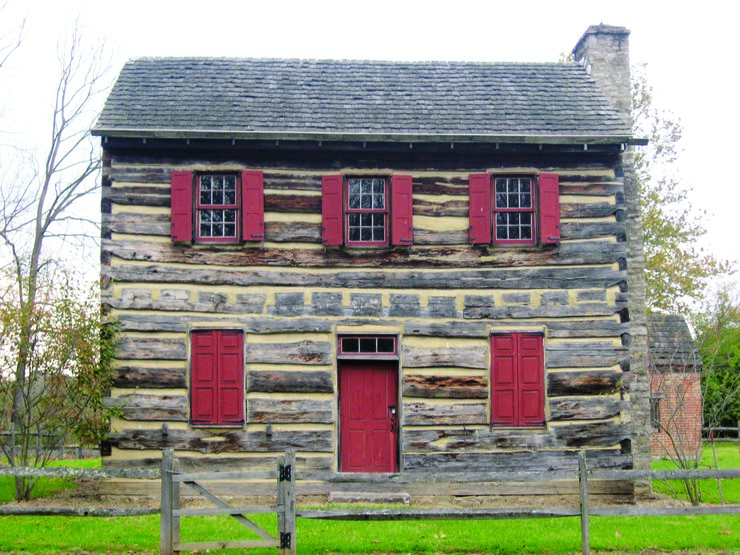
Originally named College Township—as the site of the future Miami University—this Butler County township places No. 7 this year, its first top 10 appearance. Oxford Township is home to the city of Oxford and Miami University. Congress in 1792 required land purchaser John Cleves Symmes to allocate a township of land to support a university; he never fulfilled the promise but, eventually, Miami U was established there. A low crime rate (No. 2 this year), a good school system (Talawanda City School District) and a low average commute-to-work time (about 17 minutes) make the township an attractive place to live. A part of Hueston Woods State Park stretches into the township.
8 Reily Township (Butler County)
With a doubling of its median home-sale price, a high homeownership rate (90.9%) and good schools (Talawanda City School District), Reily Township makes it second top 10 appearance in four years. One of 13 townships in Butler County, Reily was formed out of St. Clair Township in 1807 and sits just south of Oxford Township. The township, with a population of 2,786, also ranks well in safety. The median home-sale price in 2020 was $265,000, up from $125,000 five years earlier. The township is still rural and peaceful, with many rolling hills, woodlands and agricultural fields. The Indian Creek winds through the township, which was home to many Miami Indians in the early days. Reily Township Community Park, Pater Wildlife Area and Indian Creek MetroPark are located in the township.
9 Montgomery
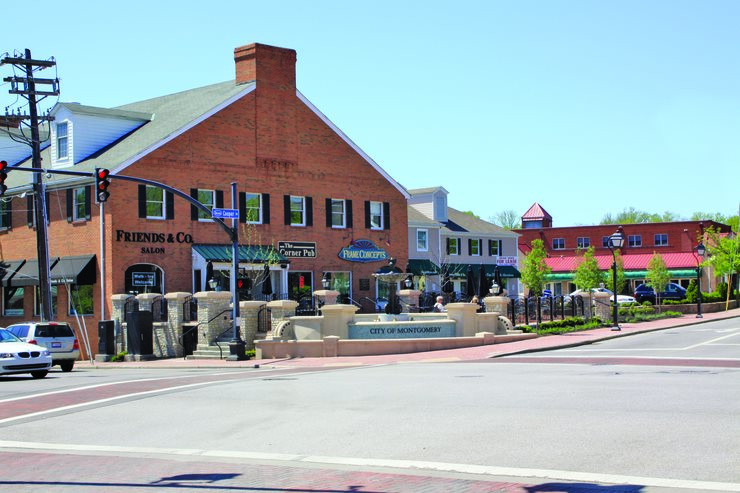
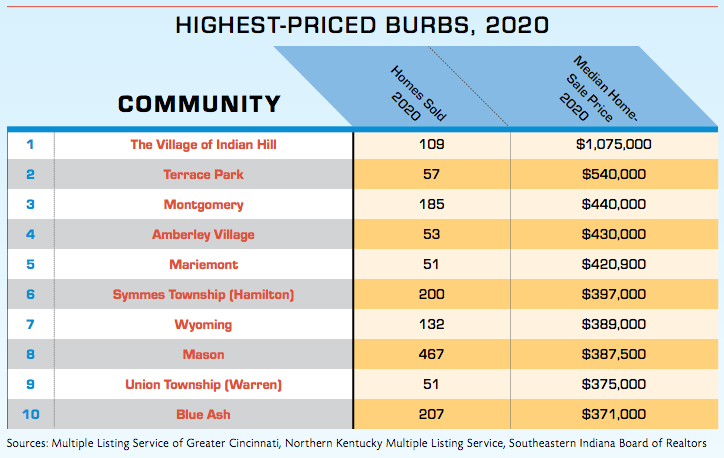
Montgomery continues its streak in the top 10, now at seven years, including No. 1 in 2018. The city of 10,872 ranks well across most categories. The 5.3-square-mile city was settled in 1796 with six families that moved from Orange County, New York. It became a village in 1910 and incorporated as a city in 1971. Montgomery residents are attracted to a top 5 school system (Sycamore Community School District), a relatively low crime rate and a high homeownership rate (86.7%). Median prices of homes sold in 2020 were up just 17%, to $440,000, as the city already is one of the highest-priced areas.
10 Mason
Warren County calls itself “Ohio’s Largest Playground,” and Mason describes itself as the anchor of Warren County. The city of 33,870 residents has become a business hub, with 24 planned business parks that contain more than 150 companies. Additionally, more than 500 businesses operate in the city’s 19 square miles. Good schools (primarily the Mason City School District), relatively low crime and a 67% gain in the 2020 median home-sale price ($387,500 vs. $232,250 five years earlier) make Mason attractive as a place to live and work. Mason is home to Kings Island, Great Wolf Lodge and the Lindner Family Tennis Center, which hosts the prestigious Western & Southern Open tennis tournament annually.
Honorable Mentions
The Honorable Mentions category shows communities that did not place among the Top 75 Communities but did place in the top 25 in at least two categories among the 138 communities of 1,000 or more population. This year, those communities are: Bethel and Williamsburg.
The Top 75 Communities
Crime & Education
How Hot is Too Hot?
Buyers chasing too few houses keep housing booming
By Bill Ferguson Jr.
If you’ve recently bought a home or you’re searching for one now, you already know that the real estate market is hot.
Just how hot? Sizzling hot—searing buyers’ patience, perseverance and pluck as houses sell right out from underneath them.
“We are witnessing probably the greatest seller’s market in the history of this country,” Ron Brossart of RE/MAX, president of the Northern Kentucky Association of Realtors, says. “It’s very difficult on the buyers—offers [accepted] are the highest and best.” He says he wrote an offer two weeks earlier on a property that had 32 offers.
All 138 communities in Cincy’s “Rating the Burbs” experienced a gain in their median-home sale prices from 2015 to 2020. The highest gains were in Lemon Township ($125,000 median price in 2020, up 410%), according to the Multiple Listing Service of Greater Cincinnati. In Kentucky, Southgate saw the highest increase, to $128,750, up 108%, the Northern Kentucky Multiple Listing Service says.
Even in this year’s No. 1 suburb, Terrace Park, already one of the highest-priced communities in the region, the median price jumped 38% to $540,000.
The Multiple Listing Service of Greater Cincinnati, which covers much of southwest Ohio, reported 26,803 closings in 2020, with a median price of $207,500, up 12.8% from 2019—both records. The Northern Kentucky Multiple Listing Service reported 7,849 sales in 2020, with a median price of $202,000, up 12.9%—also both records.
The housing market was already robust before the COVID-19 coronavirus pandemic started to hit hard in March 2020. The pandemic slowed the action, as in-person showings were reduced dramatically.
“A lot of sellers said let’s just wait, sit on the sidelines and see what’s going to happen,” Brossart, who has been in real estate for 18 years, says. That brought a big decrease in houses available, so when things gradually opened back up, there was a huge imbalance in supply and demand, with too few homes available for the pent-up buying.
Stephanie Sudbrack-Busam of Sibcy Cline, president of the Cincinnati Area Board of Realtors, says the pandemic did indeed force the industry to pivot. “The initial jolt was when we shut down, and that lasted about a month, then people started getting itchy” to house-hunt.
She says that in addition to fewer sellers, the pandemic caused people to begin working from home, creating a desire to move from apartments or small houses to larger houses; increased the demand for outdoor living amenities; and allowed people to save more money toward a home.
Additionally, the average rate on a 30-year fixed mortgage fell below 3% in 2020, and is currently hovering around 3%, giving buyers more buying power to make higher offers.
Adding to the supply issue, homebuilders are also reeling from a pandemic-related breakdown in the supply chain of many products. The National Association of Home Builders said in June this year that in a survey for the NAHB/Wells Fargo Housing Market Index, more than 90% of builders reported shortages of plywood, appliances, oriented strand board and framing lumber.
Lumber prices were up more than 300% from April 2020 to April 2021, adding almost $36,000 to the price of a typical new home, the association says. In April 2021, 27% of new-home sales were priced below $300,000, and a year earlier, 45% were below $300,000.
“I have a lot of sellers wanting to sell, but their biggest fear is where are we going to go and what are we going to do,” Brossart says. He says agents are getting creative by delaying closing to 60 to 75 days and setting a 30-day occupancy after closing to allow sellers time to become buyers who can find another house; if they find something faster, they can renegotiate possession for their buyers.
How We Did It
15th Rating the Burbs ranks top communities based on data
By Bill Ferguson Jr.
Cincy sifts through thousands of data points each year for almost 140 Greater Cincinnati communities to pull together our “Rating the Burbs” cover story/project.
The 15th edition of “Rating the Burbs” is the result of examining hundreds of spreadsheets and websites on various topics to determine the Top 75 Communities, Top Public School Systems and 50 Safest Neighborhoods in the eight-county metro region. For the most part, the COVID-19 coronavirus pandemic had little effect on data availability this year, with the exception of education.
The U.S. Census Bureau’s American Community Survey and Population Estimates Program, which updates the 2010 decennial census annually, provides data updated through 2019.
More than 270 villages, cities, townships, Census County Divisions and Census Designated Places are located in Boone, Butler, Campbell, Clermont, Dearborn, Hamilton, Kenton and Warren counties. This year’s “Rating the Burbs” survey consists of 138 jurisdictions of 1,000 or more population.
Median home-sale prices are gathered from the Multiple Listing Service of Greater Cincinnati, the Northern Kentucky Association of Realtors and the Southeastern Indiana Board of Realtors. For a few communities unavailable through those three organizations, sales are gathered from county auditors.
Crime statistics are based on the FBI’s Uniform Crime Reporting Program. The FBI lists four categories of property crime and four categories of violent crime; the latest breakdown of numbers is from 2019. Reporting to the FBI is voluntary, so for areas not reporting to the bureau, we check community and state websites, and contact our county sheriffs’ offices and township, city and village police departments.
Property-tax data come from county auditors, treasurers and property valuation administrators; we break down the tax charts to individual localities and compare taxes in each area for each $100,000 of house value.
Sixty-nine school districts serve students in at least some part of the eight-county area, and we scoured state report cards, state education department websites and school district websites for data, and we also made public-records requests to the state departments of education themselves. COVID-19 resulted in schools being closed in March 2020 for the remainder of the school year, so numbers for the 2019-20 academic year were only partly available for the education category this year. In some cases, 2018-19 data were used.
Home-Sale Prices Soaring in Most City Neighborhoods
By Bill Ferguson Jr.
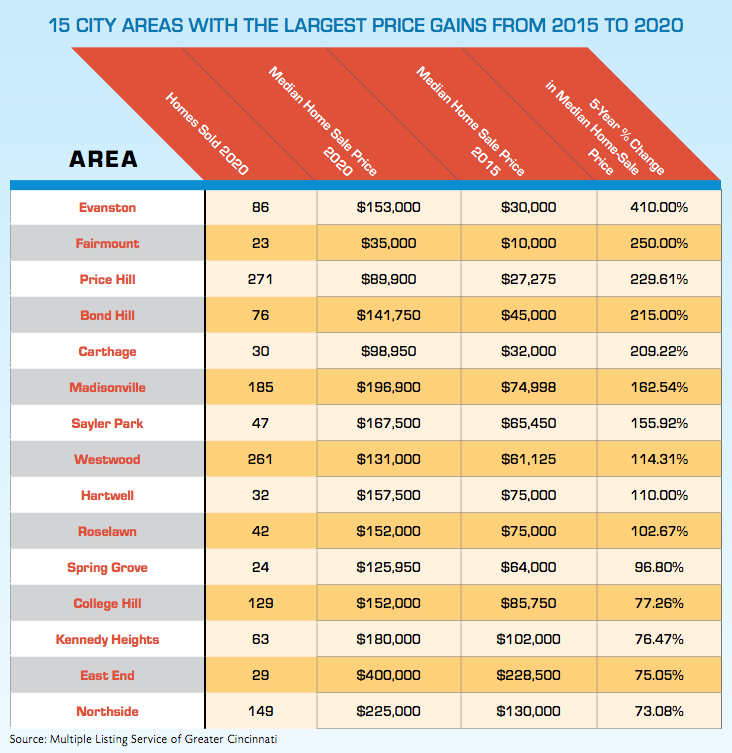
Five City of Cincinnati neighborhoods experienced at least a tripling of median home-sale prices in the past five years, with Evanston leading the list in percentage terms for the fifth straight year.
Prices in Evanston continued on a tear, more than quintupling to $153,000 on 86 sales last year from $30,000 in 2015, the Multiple Listing Service of Greater Cincinnati (MLS) reported. Houses in Evanston sold for a median price of $13,400 in 2011.
Evanston’s median price was followed by those in Fairmount, Price Hill (East, West and Lower), Bond Hill and Carthage. Another five neighborhoods at least doubled.
MLS each year provides home sales for the city for “Rating the Burbs.” Most statistics that we use to evaluate the suburbs—all areas outside the city limits—are not readily available on the micro level for the 52 city neighborhoods. The MLS breakdown covers 38 areas, which do not correspond exactly to the 52 neighborhoods, but some areas are true neighborhoods.
The most pricey neighborhoods were Mount Adams, Mount Lookout, Hyde Park, the city (Downtown/Over-the-Rhine/Pendleton/Queensgate/West End) and East End. Two areas declined in price: Linwood, by 13.7%, and Riverside, by 31.5%.