

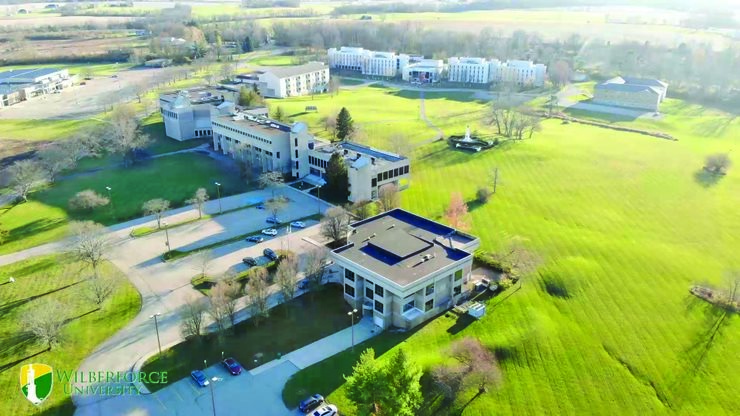
Wilberforce University remains true to its roots while preparing students for future careers
Wilberforce University, a private, liberal arts university just outside of Xenia, may be a historically important school—it’s the country’s oldest historically Black college or university (HBCU)—but it’s still working to spread the word that the education and community it provides its students remains important, even today.
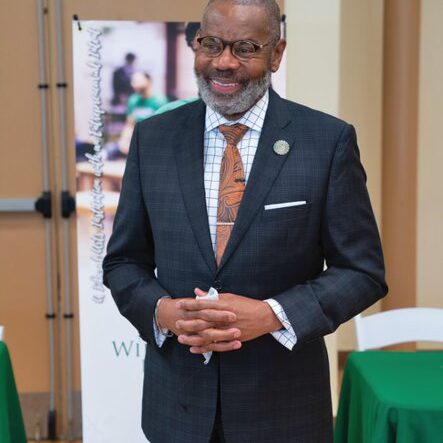
“We began in 1856 here in Greater Dayton area, which was the site of a significant community of free African Americans who had never been enslaved,” says Elfred Anthony Pinkard, Ed.D., president of Wilberforce. “Wilberforce has been a significant presence in the history of American higher education, broadly and certainly the education of African Americans.”
Wilberforce University counts among its alumni Dorothy Vaughan, a mathematician who worked for NASA and who’s story was told in the film Hidden Figures; Bayard Rustin, a civil rights leader who worked with Martin Luther King, Jr.; W. E. B. DuBois, a sociologist and influential civil rights activist; and William Julius Wilson, a noted sociologist and current professor at Harvard University.
This storied history both inspires and unites the students who attend Wilberforce. “So we say to them, you have a legacy to uphold, and we know that you can do it because it has been done before you, and this is a part of who you are,” says Pinkard.
While this history remains important, Wilberforce is also working to provide students with the skills they’ll need for the future while attacking current obstacles to education. Alongside its liberal arts education, the school has added the Center for Entrepreneurship and Innovation. The center encourages students to develop an entrepreneurial mindset with experiential learning opportunities and serves as a research hub. Another program is CLIMB, which is designed for working adults to help them finish their undergraduate degree. Students can earn degrees in criminal justice administration, health and human services, information systems management and organization management. The school also offers the Bayard Rustin lecture series; participates in the James Baldwin Writers’ Colony, which takes selected students to Europe to follow in the footsteps of writers like Baldwin; and works with The Ohio State University so that Wilberforce students can be student researchers at its Comprehensive Cancer Center.
Even with these programs, Pinkard stresses that it’s the school’s opportunities and connection that truly form the Wilberforce experience. Ronald Mathews, a 2021 graduate who is currently looking at graduate schools, agrees. Mathews was the class salutatorian, student government association president and vice president of his fraternity, Alpha Phi Alpha.
“Wilberforce offered me a lot, especially when it came to using my voice,” he says. “Wilberforce is the institution that really does care about you and your development.”
This truly sunk in for Mathews his freshman year when he was able take advantage of the university’s co-op program. Wilberforce was the first HBCU to offer a co-op program in 1964.
“I did New York for about three months. And I’ll never forget that because I had just got out of high school,” he says. “That really did build my courage, to just step outside my comfort zone.”
Pinkard adds, “This is a place that will celebrate [students], that will acknowledge their abilities and their talents, will cultivate them. We’ll join them in their journey to adulthood and to getting the undergraduate degree.”
