

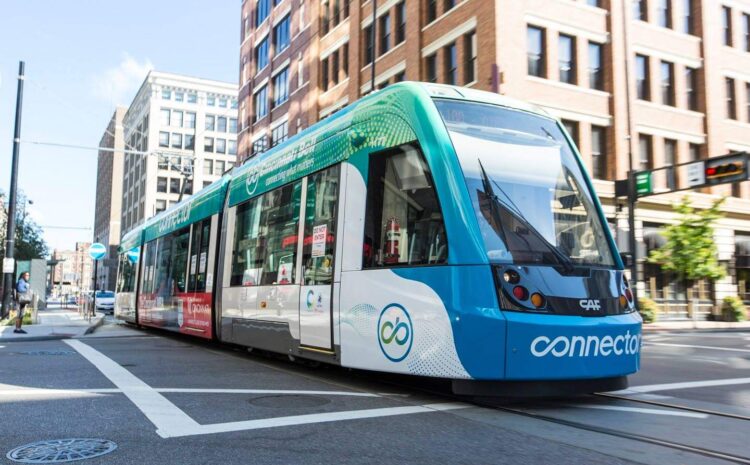
New transit possibilities on the horizon in 2022
As Cincinnatians and our local economy re-emerge from a long COVID induced hibernation, capped with a surprising Super Bowl dream sequence, some are speculating about what the future holds for Cincinnati’s streetcar and regional rail transit.
The Queen City has had a rocky rail history. As one of the largest cities in the nation at the end of the Civil War, Cincinnati was eclipsed by towns like Chicago, St. Louis and Pittsburgh that became rail hubs as we stuck to our riverboat roots. We built and then disassembled an extensive streetcar system in the 20th century. We began, then abandoned, a subway system. Union Terminal was a bustling hub for regional travel through the 1940s and 1950s, but now it hosts only handful of late-night Amtrak departures each week.
In 2002, Hamilton County voters rejected an ambitious Metro Moves plan that would have funded a regional light rail system. But transit advocates did not give up, launching a plan that became what is now known as the Cincinnati Bell Connector (aka the streetcar).
It wasn’t easy. Anti-transit conservative activists put two anti-rail charter amendments before voters. Streetcar advocates fought back, defeating them in 2009 and 2011. Former Mayor John Cranley was determined to kill the streetcar after his 2013 election, but construction had already begun and Cranley could not muster the votes on Council to pull the plug. Through his eight-year term, Cranley worked to make the streetcar a failure. Meanwhile, GOP Governor John Kasich cancelled state funding to run the streetcar uptown to UC.
While Cincinnati fought about whether to kill the streetcar, cities like Kansas City, Tampa, Tacoma, Salt Lake City, Portland and Tempe deployed available federal dollars to expand their own systems.
Cranley is now off on his quixotic gubernatorial campaign. With the Biden administration’s $1 trillion infrastructure plan enacted, rail transit activists like John Schneider, considered the godfather of the streetcar, says that “quiet conversations” are going on about what might come next.
The good news: With a new no-fare system in place, streetcar use has surged, even during the pandemic. Schneider reports that ridership already exceeds pre-pandemic levels, something matched only in Tampa, Dallas and Tucson. Along the streetcar’s 3.6-mile loop, new development and historic renovation has boomed. Local economist John Yung calculates that by the end of 2019 there had been more than $1.4 billion in investment within 1,000 feet of streetcar stops. Streetcar ridership now exceeds by five times the per hour per bus ridership of an average Metro route. Weekday ridership is also up, showing that downtown residents and workers are relying on the streetcar to connect downtown. It’s not just for weekend tourists anymore.
So what’s next? Schneider points out that while the uptown connection is appealing, the route would require two short tunnels, meaning more dollars and longer construction time. Quicker and less costly extensions might be to Camp Washington and Northside, areas ripe for development investment. Northern Kentucky transit activists have proposed a link to Newport. Transit-friendly Mayor Aftab Pureval and potential funding from the Biden infrastructure program could make it happen.
Meanwhile, federal infrastructure funding could also revive the 3C (Cleveland/Columbus/Cincinnati) high speed rail plan that Ohio Republicans killed after the defeat of former Democratic Governor Ted Strickland. The U.S. would provide construction funding, but operating fund support must come from the state. Schneider points out that even red states like Florida and Texas are expanded intra-state rail connections. Why not Ohio? A high-speed rail system linking Ohio’s urban centers and university campuses would generate more investment and jobs across the state, and better serve a new generation of Ohioans not as addicted to their cars and the suburbs as their parents.
Will Cincinnati and Ohio embrace this new opportunity to improve connections in town and around the state? Or will the moment pass in another round of bickering? Stay tuned.

Don Mooney is an attorney, a past member of the Cincinnati Planning Commission and is active in local politics.
