
Meet Vivek Ramaswamy, our city’s controversial favorite son
He is outspoken, controversial, but never apologetic. He has been described as subtle as a hand grenade in a barrel of oatmeal. After a hyper-successful, meteoric climb as a biotech entrepreneur and businessman, he seeks to enter public service as our nation’s commander and chief.
But is Vivek Ramaswamy simply seeking to further an already illustrious career, or, like our city’s namesake Cincinnatus, only seeking to enter public service to remedy what he sees as dire circumstances, with plans to return to private life once the nation’s problems have been solved?
Often seen as a neophyte to the American political scene, Ramaswamy has always had an active interest in politics, with a bent toward conservatism.
“I met Vivek when he was a senior at St. Xavier High School by a woman who reached out to me because she knew I was politically active,” says Alex Triantafilou, an attorney and judge who is now chairman of the Ohio Republican Party. “He was pretty interested in public affairs even back then. But I can’t really speak to what he did after we met. We have stayed in touch over the years through emails and phone calls. But I am not what you would call a Ramaswamy insider.
“Even as a young person, Vivek was aligned with conservatives, which grew into a more political leaning. His meteoric rise surprises me only because I knew him. But I am not the least bit surprised because he is one of the most singularly intelligent human beings I have ever encountered. He has a wealth of knowledge on more topics that almost everybody I have ever met.”
While he admires Ramaswamy, don’t take Triantafilou’s comments as an endorsement.
“We haven’t endorsed anyone for president and neither have I,” he says. “It’s certainly no secret that Donald Trump is our frontrunner right now.”
However, the same conservative fascination for turning business leaders into politicians that drives the Trump phenomenon is also creating interest in Ramaswamy.
“America is at its core a capitalist country,” says Triantafilou. “We have respect for captains of industry and have had that respect for a long time. Achieving the kind of success that Vivek has had is both noteworthy and commendable. People in the business world are tough, smart and often they have achieved in a highly competitive environment. All of those things translate well to politics and government.”
Few could argue with Ramaswamy’s business acumen or success. He is by all accounts a self-made man.
Ramaswamy attended public schools in Cincinnati through the eighth grade, when he transferred to Cincinnati’s St. Xavier High School. After graduating as valedictorian in 2003, he went on to Harvard University, graduating with a Bachelor of Arts, summa cum laude in biology.
Even then he gained a reputation as a brash and confident libertarian as a member of the Harvard Political Union, becoming the organization’s president. In 2011 he was awarded a post-graduate fellowship, which he used to attend Yale Law School, earning a Juris Doctor in 2013.
But even before he graduated from Yale, he already had a net worth north of $15 million from his dealings in the finance, pharmaceutical and biotech industries. He worked at the hedge fund QVT Financial from 2007 to 2014, where he was a partner who co-managed the firm’s biotech portfolio.
In 2014, he founded the biotech firm Roivant Sciences with a hefty amount of startup capital from QVT as well as other significant investors. The very next year, he raised $360 million for Axovant Sciences, a Roivant subsidiary, later engineering an IPO for the company that raised $315 million.
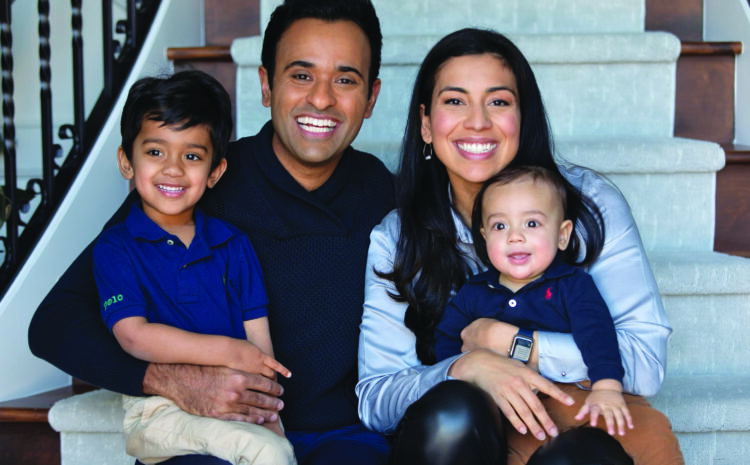
Ramaswamy met his wife, Apoorva, while at Yale where she studied medicine, earned an MD and became a laryngologist. Today, she works as an assistant professor at The Ohio State University’s Wexner Medical Center. They two have been married since 2015 and have two sons, Karthik and Arjun.
In 2020, Ramaswamy, as CEO of Roivant, established a nonprofit social-impact arm Roivant Social Ventures.
While Ramaswamy’s current presidential campaign opposes many Diversity, Equity and Inclusion (DEI) initiatives, as well as environmental, social and corporate governance (ESG) initiatives, he is not without an understanding of the hardship it takes to rise up as the son of Indian Hindu immigrant parents.
“I don’t have a lot of patience for the union bosses. That’s where he [Scott}and I have a common view,” said Ramaswamy as he addresses the crowd at the Ronald Reagan Presidential Library in Simi Valley during the last debate. “But I do have a lot of sympathy for the workers, however. People are going through real hardship in this country. I dealt with hardship growing up. My father stared down layoffs at GE under Jack Welch’s tenure at the GE plant in Evandale, Ohio. My mom had to work overtime at nursing homes in southwest Ohio to make ends meet and pay off our home loan.
“So, I understand that hardship is not a choice, but victimhood is a choice, and we choose to be victorious in the United States of America.”
Ramaswamy knows what it means to be victorious and learned how to win at a very young age.
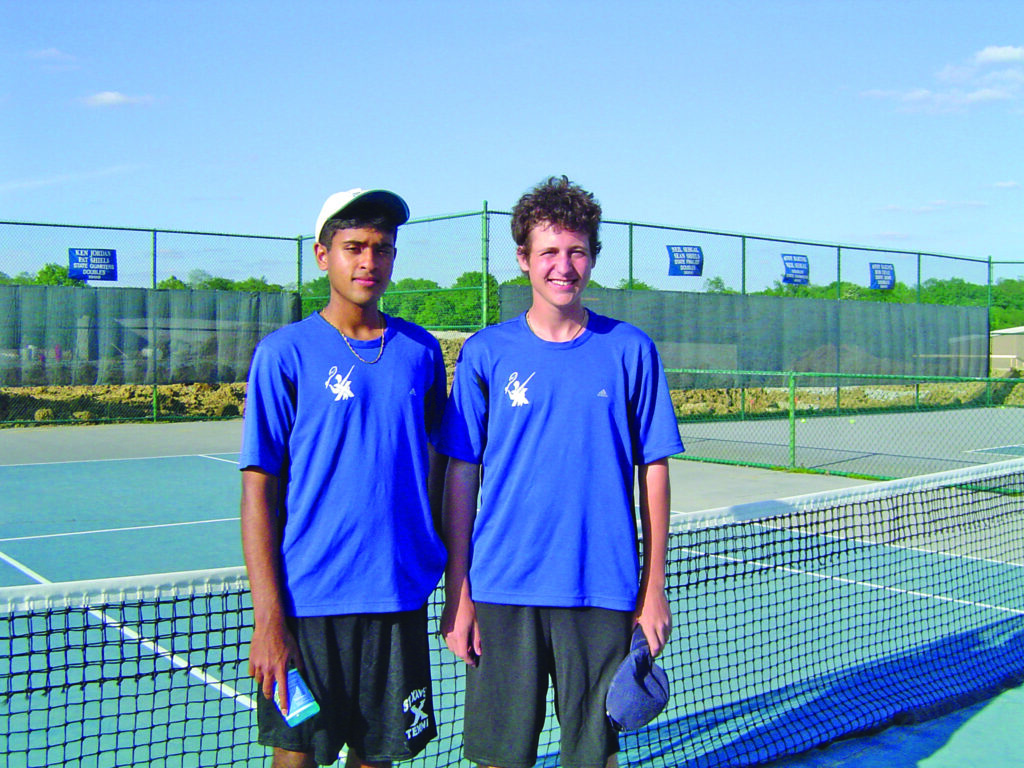
“I met him at around age 12,” says Cory Ingle, a Cincinnati attorney, who went to high school with Ramaswamy. “We played tennis together and played in competitive tournaments through USTA (United States Tennis Association) sanctioned events. We were both competitively ranked tennis players. And we both played up at Queen City Racquet Club and Fitness Center.”
Describing Ramaswamy as a “baseline, groundstroke and very consistent player,” Ingle is quick to add that Ramaswamy had numerous interests, especially when he entered St. Xavier High School.
“I was actually a year behind Vivek,” says Ingle. “He was very well known and had the highest GPA in the school. But he was very personable and had a great family, with a tremendous upbringing. His family was always there and was always very supportive.”
Ramaswamy’s father, V. Ganapathy Ramaswamy was a graduate of the National Institute of Technology Calicut and worked as an engineer and later as a patent attorney for General Electric, while his mother, Geetha Ramaswamy, is a graduate of Mysore Medical College and Research Institute, later working as a geriatric psychiatrist. The two immigrated from Palakkad district in Kerala, where the family had an ancestral home.
Born and raised in Ohio, Ramaswamy often attended a local Hindu temple in Dayton, but attending St. Xavier, a Catholic school with the Jesuits, did impact his social views today.
“He did play tennis, but the real thing to take away was that he was very well rounded,” says Ingle. “Even back then, you could tell he was something of a Renaissance man. He was always involved with numerous clubs and associations.”
But he never made much of his involvement or bragged about his accomplishments, being what Ingle described as a “very private” person.
“You would play tennis with him during the week, and then not see him over the weekend,” recalls Ingle. “Then you would come back on Monday and find out that he had won a mock trial competition, which you didn’t even know that he had been preparing for. As for politics, he wasn’t particularly outspoken, He was interested in the political issues of the day, but he wasn’t going around picking debates with people over it.
“I always expected great things from Vivek, but I was a little surprised when he came into the public sphere. Then, when he wrote the book and started going on cable news, I was a little surprised that he jumped into the realm of being such a public figure.”
Actually, Ramaswamy has written two books: Woke, Inc.: Inside Corporate America’s Social Justice Scam and Nation of Victims: Identity Politics, the Death of Merit and the Path Back to Excellence, which was published last year just before his announcement to enter the presidential campaign.
“If I was going to give advice to those workers [UAW workers on strike], I would say go picket in front of the White House in Washington D.C., that’s where the protest needs to be,” said Ramaswamy. “Disastrous economic policies that have driven up prices, that have driven up interest rates and mortgage rates at the same time wages remaining stagnant.
“What we need to deliver is economic growth in this country,” he added addressing the crowd at the Reagan Library. “Unlock American energy, drill, frack, burn coal, embrace nuclear energy, get people back to work by no longer paying them money to stay at home. Stabilize the U.S. dollar itself and rescind the majority of those unconstitutional federal regulations that are hampering our economy.
“That is how we unleash American exceptionalism, and that is not a Democrat or Republican vision. That is an American vision that we embrace economic growth. Capitalism is still the best system known to man to lift us up from poverty and we should not apologize for it. That’s what it means to be an American.”
So is Vivek Ramaswamy the next coming of Cincinnatus? Will he ever leave public life once he has accomplished his goals?
“I think you’re probably correct in assuming he is a something of a modern-day Cincinnatus who might leave office once he has accomplished his goals,” says Ingle. “But I think he will always be motivated. He will always have various callings in his life.
“I don’t think he’s ever going to go sit on a beach.
