

Local doctors work to bring down the barriers—and anxiety—that surround breast cancer screenings
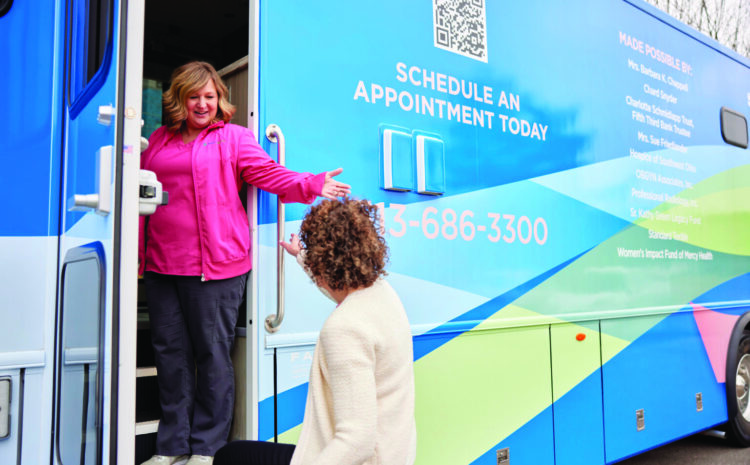
Ten years ago, Dr. Alaba Robinson turned a mammography van into a party bus. To celebrate her 40th birthday, the Mercy Health primary care practitioner invited patients to join her for a breast cancer screening.
Now, it’s an August tradition—and nearly 90 women received mammograms at Robinson’s 2023 “Breast Birthday Ever.”
“There’s so many fears around getting a mammogram. Some women may not get it because they don’t think they can afford it or they’re afraid of the results,” Robinson says. “And so my goal was to decrease disparities in the community.”
When to Start Screenings
Breast cancer screenings are often a source of fear or confusion as women approach their 40s. Various health bodies advocate for women to begin getting mammograms at age 40, 45 or 50, with some advising yearly screenings and others sticking with two.
The three health care professionals interviewed for this story—a surgeon, a radiologist and a primary care practitioner—all said that women with no other risk factors are usually advised to start receiving mammograms around age 40, and that testing every year is preferable.
“The bottom line is that women should have conversations with their health care providers about what’s right for them and taking into account things like breast density and family history and personal history,” says Dr. Jennifer Manders, a breast cancer surgeon at The Christ Hospital.
What Can Patients Expect?
A mammogram takes five to 10 minutes in total. Manders says most patients can expect discomfort, but not pain, as the breast is compressed for the screening.
Afterwards—likely after a period of one to two weeks—the lab will send results. It’s not uncommon to be called back for further screening, and most patients who get called back in have benign findings.
Most health systems also have options to make mammograms affordable for low-income patients, and Robinson notes that you don’t need to have a primary care physician to get screened for breast cancer.
Beyond the Mammogram
A mammogram may not return definitive results. One common reason is a high amount of dense tissue in the breasts, which can mask cancer on the mammogram, making supplemental testing necessary in some cases.
“Cancers look white on a mammogram and so does dense tissue,” says Dr. Ann Brown, a breast radiologist at UC Health. “We say it’s like trying to find a snowball in a snowstorm.”
Women with dense breasts make up half of the over-40 female population, and they also have a higher chance of developing breast cancer. If a lot of dense tissue shows up on the mammogram, doctors are likely to recommend a supplementary screening using ultrasound or MRI technology.
Last year, Brown co-wrote House Bill 371, a piece of Ohio legislation that lowered some barriers to care, extending insurance coverage for mammograms and the supplemental screenings that are required for women with dense breasts. It made testing more accessible, but there’s still work to be done. In the future, Brown hopes insurance coverage for testing will extend even further, and also hopes to improve understanding of supplemental screenings among health care professionals.
“As patients are more informed, their providers should be, too,” Brown says.
