

Terence Hammonds’ artwork lands at the Weston Gallery
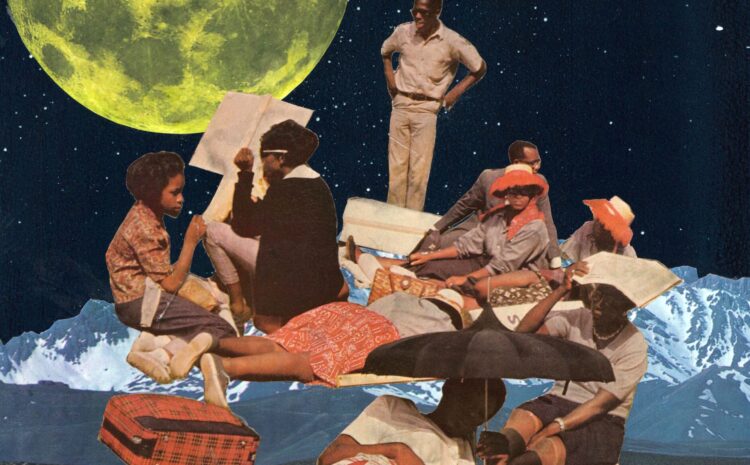
In outer space, couples dance atop asteroids. Young men contemplate the cosmos among gardens on the moon. Meanwhile, an oversized Baby Ruth bar floats through the heavens.
While this may seem like a scene out of a science-fiction film, Cincinnatians will soon be able to experience the outer edges of the galaxy at downtown’s Weston Gallery.

The gallery, in the same building as the Arnoff Center, will host Terence Hammonds’ “Transmission from the Mothership” through March 15. The exhibit will see Hammonds combine images from 20th-century magazines and turn them into astrological collages.
A Cincinnati native, Hammonds’ exhibit at the Weston Gallery comes from a decades-long relationship with the city. Raised on Main Street in Over-the-Rhine, Hammonds attended the School of Creative and Performing Arts before leaving for art school in Boston. Today, he teaches at the Art Academy of Cincinnati, just a block over from the street in which he was raised.
“I am always curious about an art process and the resulting work as a vessel for labor, vocabulary and ideas. Terence’s work epitomizes this,” says Michael Goodson, director of the Weston Art Gallery. “Collapsed into these 23 works are notions concerning the complexity of collage as a visual index.”
Beyond the juxtaposition of earth and space, Hammonds’ work looks to reconstitute images of “Black pain and struggle” with a futuristic yet nostalgic setting.
This interest in a retro-Afrofuturism of sorts perhaps goes back to Hammonds’ youth. Growing up in the ‘90s, Hammonds regularly listened to pop punk.
“I loved [the] social transgression [of the genre],” Hammonds says while noting that liberation in the face of adversity was a common theme in older, Blacker genres like jazz and funk as well. “The ‘60s were so much about civil rights … in the ‘70s, the music changed to be about looking to space for some sort of freedom. And I changed to start looking to space for some sort of freedom.”
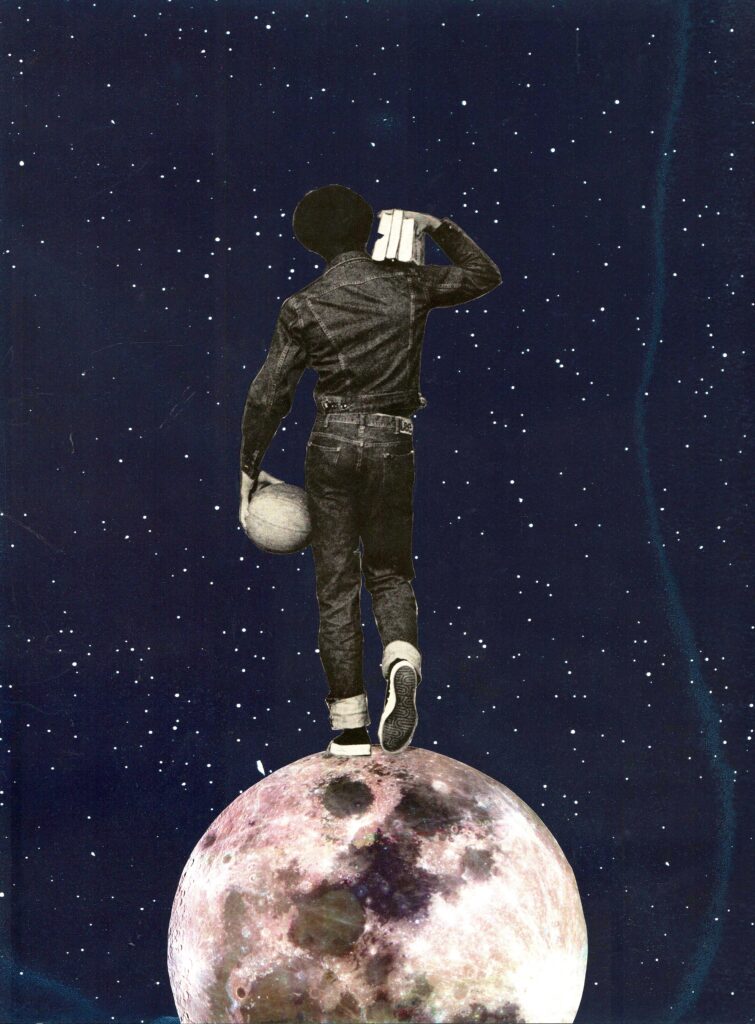
To combine these images of the past, Hammonds searched through old copies of Life and Ebony magazines. It’s here that Hammonds again found a juxtaposition, one involving two different Americas.
“Life magazine was really geared toward a white audience. And then Ebony Magazine was obviously geared toward a Black [audience],” he says.
The difference, Hammonds says, is that the Black people featured in Life were often featured in the context of pain, while Ebony included a more holistic look at life as a Black American, including joy. “When they’re put together, I find them intriguing… I find it an interesting way to recontextualize history.”
In recontextualizing historical imagery, Hammonds acknowledges the fine line between reframing the past and revising it.
“All this revisionist history and telling this whitewashed version of slavery and history, I don’t want to be a part of that. But I also don’t want to perpetuate more images of Black pain,” Hammonds says. “I want to make images that my kids can be proud of and are hopeful. But also keeping the whole fullness of what American history is intact as well.”
