

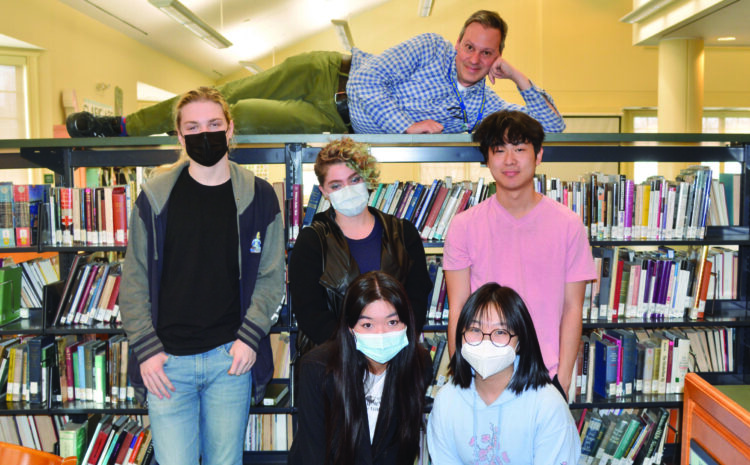
Students at The Seven Hills School were challenged to write a novel in one semester
This past spring, a group of juniors and seniors at The Seven Hills School took on the challenge of writing a novel—from start to finish. This challenge was part of the Upper School’s creative writing seminar, taught by Caleb Paull.
Paull got the idea for the assignment from his sister, who is a middle school teacher in Providence, Rhode Island. She has her seventh-grade class write novels every year.
“I thought, ‘Oh, if her seventh graders can do it, I bet my juniors and seniors can do this,’” says Paull.
While his sister’s class typically work on their novels throughout the year, Paull’s students had only one semester. Not only did they have just the spring, but the class also didn’t meet every day, so the students had even less time.
The seminar helped students improve their writing skills and taught them how to navigate the writing process.
“I think one is that they learned to sort of be able to push through times where they felt completely stuck,” Paull says. He helped to guide them through writer’s block with exercises to look at elements of the novel in a different way.
“So character is just one example,” Paull says. “Where it’s like, OK you’re stuck. Let’s explore how well you know your character. Do you know that character well enough that I can throw any setting at you, any situation, and you know how they would react? If not, let’s push further on getting to know that character and then come back.”
Throughout the seminar, the students followed the development of each other’s novels and shared ideas about how to improve and edit. They were interested in their peers’ stories and worked together through some of the obstacles.
“I think [the students] also learned that writing a novel not only doesn’t have to be a solo process but that it can really benefit from being a community process,” Paull says. “They came to recognize that maybe one person in the class was exceptional in terms of bringing out the setting while another person was exceptional in character development. So they would sort of turn to each other when they got to those things that maybe weren’t their strengths, but recognized that it was someone else’s strength.”
Paull learned multiple things in teaching this assignment, with one being how to help the students keep the writing going. He added that some students almost stay in their writer’s block as a defense mechanism.
“The only way I was going to help students through it was to tell them that they could write things that were terrible,” says Paull. “It can be something you go back and you’re like ‘This is the worst thing I’ve ever written.’ But it’s going to lead you to something else.”
Paull says he would do this kind of challenge again, with the condition of the students being a committed group.
“I think most of the students I encounter would be ones who would really just want to explore different types of creative writing,” Paull says. “But if I knew that there was a group of students, like I knew this time, who were up to the challenge because it is hard, then I would absolutely do it again.”
He adds that the sense of community between the students was unique.
“I’ve never seen a class like that before where they were so excited to celebrate each other’s accomplishments,” says Paull. “And that makes it worthwhile.”
