

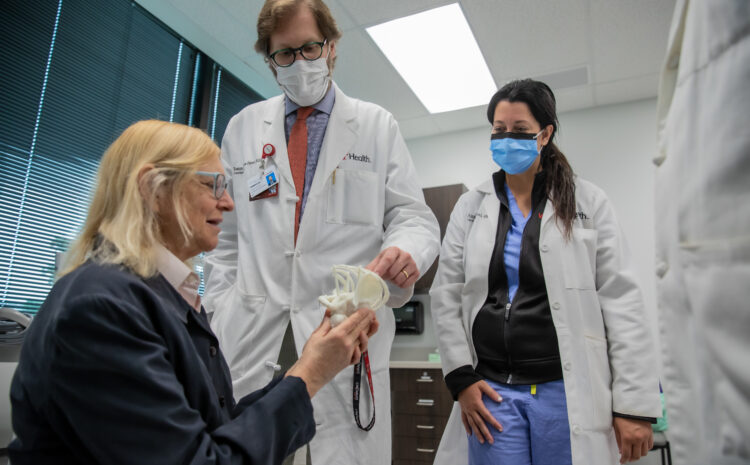
Region’s health-care systems investing millions in cardiac services and technology
Heart disease is—and has been for many years—the leading cause of death in the United States.
And it’s getting worse.
In one year, 2019 to 2020, the number of cardiac deaths nationwide grew 4.8%, the biggest increase in 10 years, according to the Centers for Disease Control and Prevention.
That helps explain why Greater Cincinnati’s health-care systems are expanding their cardiac services, investing millions in new facilities, physicians and technology.
“Our goal is to help our community become healthy,” says Mark G. Witte, vice president of TriHealth’s clinical service lines that include its Heart Institute. “It requires a more advanced cardiovascular delivery system, as we face the reality of the community that we serve and the growing needs that we have.”
TriHealth is establishing a new heart hospital on the campus of its Bethesda North Hospital. The project will add 40,000 square feet of clinical space to the Bethesda North footprint and will modernize another 80,000 square feet of existing space. TriHealth officials broke ground on the project in February, and the first phase is expected to be completed in the summer of 2022.
The project will increase capacity for all cardiac services, TriHealth says. The number of labs for procedures such as cardiac catheterization will be increased, as will space devoted to pre- and post-procedure care. The number of beds in its cardiovascular intensive care unit will be increased, and rooms will be modernized. A hybrid operating room will be built to accommodate multidisciplinary procedures that address structural heart conditions, atrial fibrillation and stroke.
“It will be a new experience and level of care for patients,” Dr. Stephen Lewis, chief of TriHealth’s cardiovascular system, says. “It will be an entire new system for cardiac care here.”
The project was partly funded by a $10 million gift to the Bethesda Foundation by Harold and Eugenia Thomas. Harold Thomas is a former vice president of sales and marketing for Thomas Foods and its successor, Sysco Corp. Eugenia is a former math professor at the University of Cincinnati.
Plans for the heart hospital began three years ago when TriHealth consolidated its two cardiac surgery programs—at Good Samaritan Hospital and Bethesda North—under one roof at Bethesda North.
St. Elizabeth Healthcare in November opened a major expansion of its Heart and Vascular Institute, with the opening of a 67,000-square-foot facility at its Edgewood, Kentucky, campus. The expansion and consolidation brought more than 30 multispecialty physicians and 30 advanced-practice providers from multiple office sites to one central location.
The new facility houses cardiology, cardiac electrophysiology, cardiac surgery and cardiac rehabilitation services, as well as an outpatient cath lab, St. E’s Advanced Heart Failure Management Center, its Structural Heart and Valve Center, diagnostic services, cardiovascular genetics, cardiac clinical trials and an onsite lab.
The Heart and Vascular Institute opened in 2015, and since then, St. Elizabeth officials have added cardiac specialists and adopted new technology, including tiny wireless pacemakers that can fit inside the heart, implantable heart pumps and heart valves that can be replaced without open-heart surgery.
“With the opening of the new facility, we are uniquely positioned to offer exceptional cardiac care and patient experience in one central location, close to home,” says Dr. D.P. Suresh, a cardiologist and executive medical director of the St. Elizabeth Heart and Vascular Institute.
With a $7 million donation from William Yung III, the owner of Crestview Hills-based hotel and casino company Columbia Sussex, the Heart and Vascular Institute was renamed the Florence Wormald Heart and Vascular Institute at St. Elizabeth, commemorating Yung’s mother.
The Christ Hospital Health Network established its heart and vascular institute in 2020, and Dr. Dean Kereiakes, the longtime leader of its cardiac programs, was named president in January.
Christ Hospital officials say their goal for the Heart and Vascular Institute is for it to become a national destination for sub-specialty patient care and clinical research trials.
“The cardiovascular services at Christ Hospital have grown in scope, reach and expertise over decades, but change has accelerated in the past few years,” says Dr. Eugene Chung, medical director of the heart and vascular service line, when Kereiakes’ new appointment was announced.
Christ Hospital in February announced a new treatment for patients with certain kinds of coronary artery disease. A new application of lithotripsy, which uses sonic waves to break up calcium, similar to the treatment used for kidney stones, is now available at Christ to treat calcium in the coronary arteries.
In March, Christ said it became the first hospital in a four-state region to implant a minimally invasive aortic valve in a procedure that did not require open-heart surgery.
Minimally invasive heart surgery also was advanced at UC Health this summer, as cardiac surgeons performed the first endoscopic triple-valve surgery in the country. In a single incision roughly one-inch long, the team replaced the aortic and mitral valve and repaired the tricuspid value—the “triple valve” surgery—of a 63-year-old woman. The endoscopic approach is the least invasive surgical procedure possible.
The procedure was led by Dr. Tommaso Hinna Danesi, who UC says is one of only 12 physicians in the world capable of performing an advanced endoscopic heart valve surgery, a procedure that leads to faster recovery and reduces surgical time by 50%.
“The patient experiences less pain, has a shorter hospital stay and, overall, a faster recovery and back-to-normal life,” Hinna Danesi says.
Mercy Health marked a milestone in May, when cardiac surgeons completed the 4,000th open-heart procedure at the system’s hospital in Fairfield. The Butler County hospital in December is also noting the 20th anniversary of its open-heart program.
Mercy’s program in Fairfield has grown over the years to include aortic surgery, minimally invasive cardiac surgery, robotic thoracic surgery and vascular surgery.
“Our investments in the heart-surgery program ensure patients receive their care in modern operating rooms and intensive care units supplied with the latest equipment,” Fairfield Hospital President Justin Krueger says.
Mercy Health has also expanded its Heart Institute practice to Milford, where it offers stress testing and echocardiograms, and to Lawrenceburg, Indiana, where echo testing and lab draws are offered, spokesperson Nanette Bentley says.
Mercy Health launched a cardiac MRI program in late 2020 at Jewish Hospital. The program has served patients who’ve recovered from COVID-19 but have developed myocarditis as a result of the illness.
