

Vein Center of Cincinnati utilizes new treatments to give patients relief
Arteries carry oxygen-rich blood to tissues in all parts of the body—a process that many know because of the prevalence of information about artery disease, which can lead to heart attacks.
The other side of the two-way system—veins, which carry oxygen-depleted blood back to the heart—often doesn’t get the same attention.
And that’s a problem because many health issues that come from diseased veins can be corrected, Dr. Andrew Hearn, owner of The Vein Center of Cincinnati, says. Hearn, a vascular surgeon since the late 1990s, decided to leave the hospital system and start his outpatient clinic, at 7426 Beechmont Ave. in Anderson Township, in 2020 after he saw so many patients suffering from chronic venous diseases that were not life-threatening but that were making life miserable.
He says he would be called to the emergency room for life-threatening bleeding, strokes or leg amputations, but “the low-level intensity of venous disease doesn’t hit your radar as much.”
Such conditions include:
– Chronic venous insufficiency, in which the veins are unable to properly transport blood from the legs back to the heart because of a problem with the vein wall or valve.
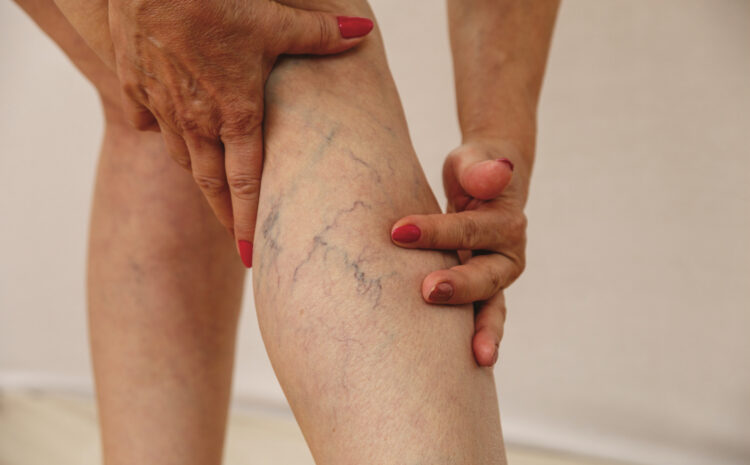
– Varicose veins, which are enlarged, ropy and twisting blue vessels in the veins near the skin’s surface.
– Spider veins, formally named telangiectasias, in which there are broken capillaries and are red, blue or purple thread-like veins.
– Restless legs syndrome, an inability to keep legs still because of a “creeping” feeling or tingling, burning, aching or numbness of the legs.
– Venous ulcers, which are shallow skin wounds caused by static blood flow, primarily below the knee.
– Deep vein thrombosis, when a blood clot forms in one of the deep veins, usually in the legs, after a long period of inactivity. Airport stores started selling support stockings to help on long flights to address this problem, Hearn says.
“Patients with vein disease don’t come into the ER with their problems, they don’t get admitted to the hospital—they’re living with it in chronic fashion,” Hearn says. “If you look at the Medicare data and how many vein treatments are being done in Cincinnati, it’s well underserved.”
While definitive numbers are difficult to find, websites, such as the Centers for Disease Control and Prevention, and medical journals, such as Circulation, estimate that at least 30 million Americans suffer from such conditions.
When do patients tend to seek help from Hearn? “Overall, most of the patients are coming in with symptomatic complaints. Primarily, patients have symptoms affecting their legs, such as swelling, aching, tiredness or heaviness.”
The other portion of patients seek help when they have unsightly veins, such as spider veins. “They don’t want to wear shorts in summertime,” Hearn says. “The whole family will be at the pool, and the vein-disease patient will show up with jeans on. It’ll be ‘Hey, Mom, why are you wearing jeans at the pool?’ ‘Mind your own business’ type of thing. It affects their lifestyle.”
He says about 90% of patients are in the symptomatic group, and their care is covered by insurance because the clinic is addressing symptoms.
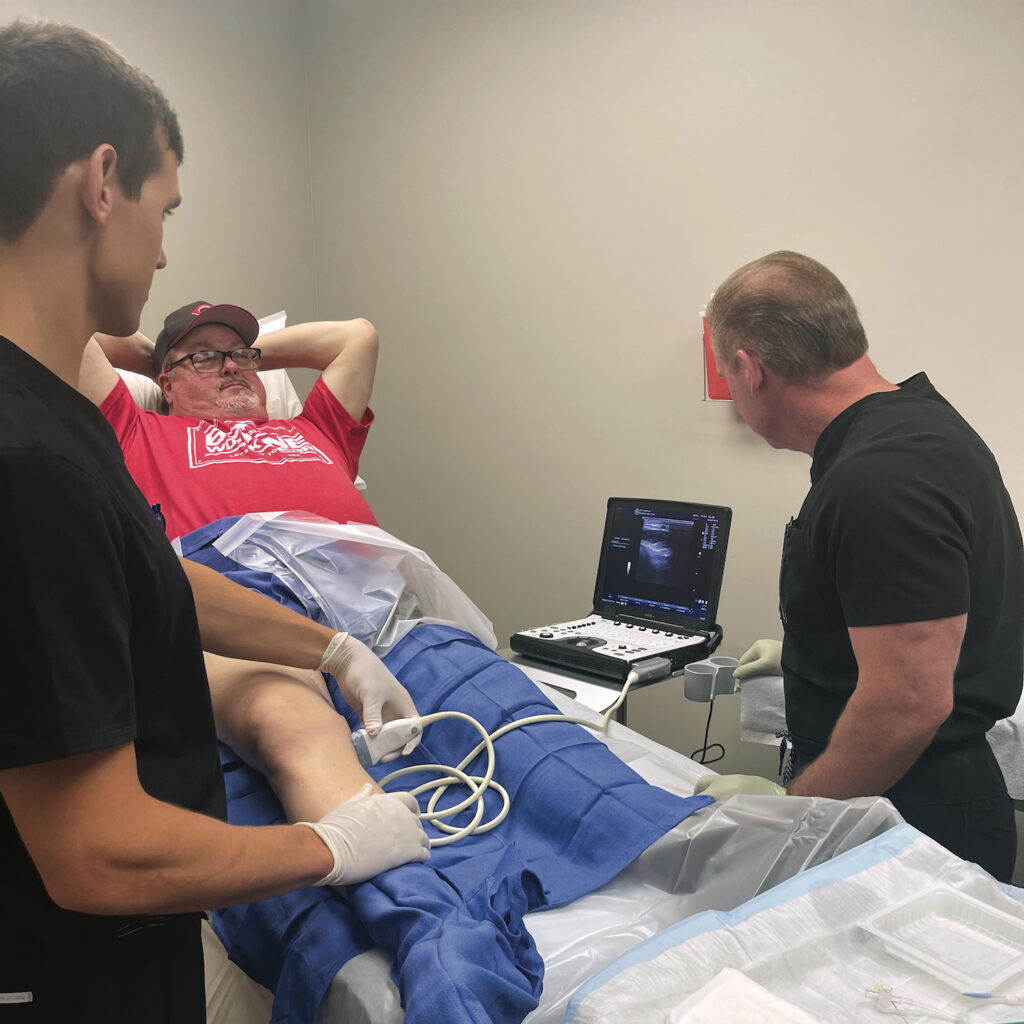
Hearn says that when patients come in, the clinic quizzes them carefully to determine symptoms. A Doppler ultrasound is then performed.
“The ultrasound is just like the guy on the weather station,” he says. “They can tell which direction the clouds are moving with a high degree of accuracy. With the venous Doppler, we can tell which direction the blood is flowing in the veins. What happens often is there’s a vein just below the surface that has absent-valve function, and the Doppler shows that it is refluxing, or flowing backward, toward the foot. The goal of the treatment, therefore, would be to ablate or seal off that unhealthy vein.”
Hearn can put a laser or a foam-like medicine into the affected vein. There’s also a medically compatible glue.
“All of these minimally invasive procedures are done through one intravenous (IV) access into the vein. One of the questions I get from patients is ‘Don’t I need that vein—am I going to be worse in the future if you shut that vein off?’ Because there’s such a diverse network of veins, all interconnected, the leg gets so much better when we fix it, because when we seal that unhealthy vein off, that diverts the blood flow into the healthy veins that are flowing properly and eliminates that backward flow, eliminates the reflux in the leg.”
Most vein issues are genetic, he says. Most arterial disease is environmental—“not exercising or eating right and a high degree of smokers and diabetes, which oftentimes is environmental from poor sugar intake”—and tends to appear late in life.
He sees patients who are in their teens all the way up to people in their 90s.
“It’s not uncommon for us to see a 15- or 16-year-old healthy person with big, bulgy, ropy veins that ache and are symptomatic, and it’s just going to get worse over their lifetime. Sometimes, they put it off, and it gets more obvious in their 20s or 30s.”
In the past, patients had to undergo major surgery—a vein stripping in which a number of cuts had to be made. “Some people come in and say, ‘I had vein stripping 30 years ago, and it was the worst experience of my life. I woke up with 122 incisions on my legs, it was terrible, and I would never do anything like that again.’”
With the new procedures, “we can put a Band-Aid over the entry site where we fixed the vein, and they can drive themselves home and go right back to work or to the gym.”
He says many primary-care physicians still aren’t aware of the new treatments. “If you’re a family doctor, why would you send a patient with chronic leg swelling or aching to a specialist if there’s no good treatment?”
Hearn says some of his favorite treatments were FDA approved as recently as five years ago.
What can you do to avoid vein disease? “In some ways, it’s impossible to avoid because of genetics. If your mother and your father have terrible veins, you’re pretty much at risk.”
To help, however, he recommends three mitigations:
– Consider medical-grade support stockings to keep pressure on the veins.
– Elevate your legs. “The center of gravity for your body is your heart; to really get your legs elevated means getting your feet at your heart level or above. I joke around with patients, ‘Your legs would be totally fine if you’d just walk around on your hands all of the time.’ It gives them a bizarre picture to make my point.”
– Exercise. “When you’re moving, you’re walking, you’re flexing and relaxing the calf muscles, which is like a pump. Everyone knows that you have a pump in your chest, the heart. The calf muscles of your legs are like the pump of the vein circulation of the lower legs.”
Hearn says vein disease “slowly, subtly, insidiously kind of creeps up on you, and it starts slowing you down. Oftentimes, it’s a correctable venous disorder. A patient, when we fix them, will often say, ‘I wish I would’ve gotten this fixed 10 years ago.’”
