

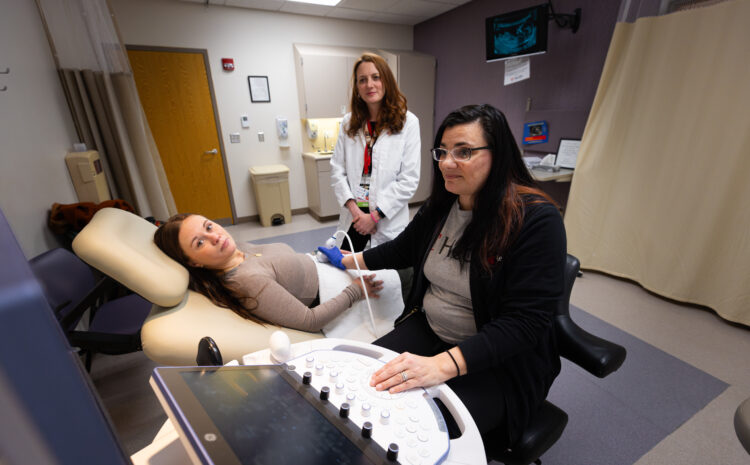
Local health care systems offer an array of resources for giving birth
Finding out one is pregnant is a significant moment in one’s life. Starting or growing a family is an exciting prospect for many, but the following 40 weeks can prove to be a challenging time.
While many women give birth—Pew Research reports that by 44, 86% of women will have given birth—pregnancy can be risky.
“Pregnancy is such a profound time for moms as far as their health goes… when it goes bad, it can be devastating for both mom and baby,” says Dr. Heather Masters, obstetrics and gynecology physician at the University of Cincinnati. “Giving patients the information and power to make the best health decisions for themselves and their family can really impact their lives.”
Working at the cornerstone of diabetes and pregnancy, Masters says she can be seen as the “doom and gloom doctor.” Despite that, she also acknowledges that this can be a formative time for not just the mother and unborn child, but the whole family, for many years after the birth.
“Women usually make a lot of health decisions for their families, so I have the opportunity to impact not only her short-term and lifelong health and her baby’s short-term and lifelong health, but also her family’s,” says Masters.
While some pregnancy risks are tied to pre-existing conditions, Masters says many complications can catch people off guard. “Some pregnancy complications develop with pregnancy itself,” Masters says. “Even people who were healthy beforehand can develop problems during pregnancy.”
One of the most common examples is diabetes during pregnancy, which can arise without a prior diagnosis. Risk factors include a personal or family history of diabetes; conditions such as polycystic ovarian syndrome, obesity or high blood pressure; or having previously delivered a baby weighing more than nine pounds—something many patients don’t realize increases their risk.
More broadly, Masters says high-risk pregnancies can be influenced by a range of factors, including chronic medical conditions, pregnancy-related complications such as preeclampsia, and even barriers like transportation or access to care, which can affect outcomes if left unaddressed.
“We think a lot about how your entire life interacts with the medical problem,” Masters says. “It doesn’t matter who you are, what your skin color is, how much money you make, or what language you speak. We want to give you the best possible outcomes and care for you holistically as a person.”
For Masters, addressing risk also means empowering patients to take an active role in their care, helping pregnant women feel informed about what pregnancy means for them.
“We want to know what you’re worried about so you can get what you need out of the visit… You’re not giving power to the problem by asking about it,” she says. “You’re just helping educate yourself.”
