

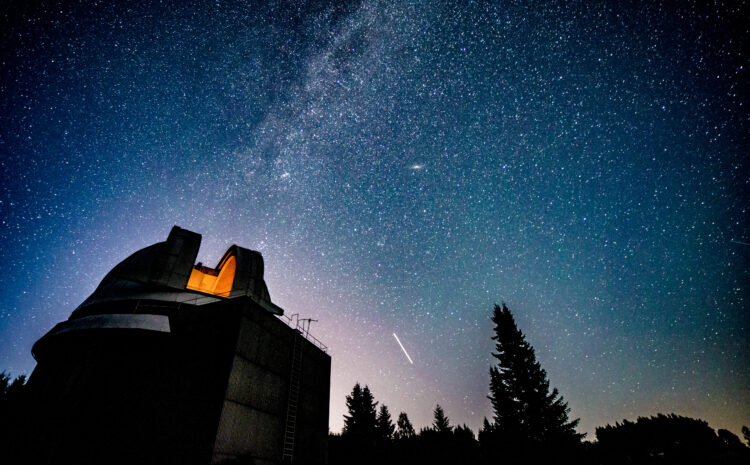
This week’s Harvest Moon, other nighttime wonders are just a telescope away
The autumnal/fall equinox—or the beginning of fall—officially occurs at 3:20 p.m. Eastern Daylight Time Wednesday in the Northern Hemisphere. The sun will be directly above the equator, and day and night hours are roughly equal. The Harvest Moon is the full moon nearest the fall equinox. The moon was at its fullest Monday, but it will continue to be bright in the nights ahead. Now is a good time to get acquainted with the Cincinnati Observatory.
The Cincinnati Observatory, 3489 Observatory Place in Hyde Park, offers many in-person and virtual astronomical educational events for children and adults, as well as viewings of the night sky. The Observatory, known as “The Birthplace of American Astronomy,” was dedicated in 1843 in a ceremony overseen by former President John Quincy Adams, who gave his last public speech there. Its main telescopes are an 11-inch Merz and Mahler refractor from 1845 and a 16-inch Alvan Clark and Sons refractor from 1904.
Some upcoming online classes and events (register online):
Daytime tours, noon, 1 p.m. and 2 p.m. Tuesdays, Thursdays and Sundays.
Astronomy Friday, 8 p.m. Friday: Take a tour of the Observatory buildings and view the sky through the historic telescopes (weather permitting).
Stonelick Stargazers (when skies are clear), Saturday and Oct. 2, Oct. 30, Nov. 6, Nov. 27, Dec. 4: Ohio’s Stonelick State Park, 2895 Lake Drive, Pleasant Plain, hosts the Friends of the Observatory’s dark sky viewing site. Near the time of the New Moon, amateur astronomers set up a variety of telescopes inviting the public to view the wonders of the night sky. It’s a great opportunity to view planets, galaxies, nebulae, star clusters and stars, see the many telescopes and ask questions.
4th Sunday History Tours, noon and 1:30 p.m. Sunday. Learn more about the Observatory’s history in a more detailed, in-depth guided tour than the daytime tours.
Discover the Observatory’s role in weather forecasting and timekeeping as well as a visit to its interactive Sundial, original 1843 cornerstone and more.
Explore Our Sister Planet, 7 to 8 p.m. next Wednesday: Venus is the closest planet to Earth and appears bright in the night sky. Its surface is shrouded in mystery, so astronomers will delve deep into heart of Venus and reveal its secrets.
What’s Your Constellation?, 7 to 8 p.m. Sept. 30: Hear the story of 12 famous constellations that make a ring around Earth. From Aries to Pisces, the constellations were essential in marking the paths of the planets, telling time and predicting earthly events.
Virtual Astronomy Club for Kids, 4:30 to 5:30 p.m. Oct. 6 (Exoplanets) and Oct. 20 (Black Holes): The event is a virtual Cosmic Kids club, geared for grades K-5.
Have questions? Go online to the Observatory’s website or call 513.321.5186.