

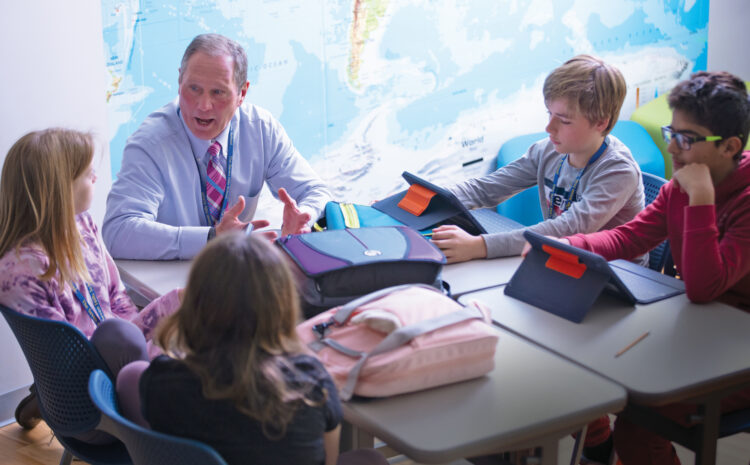
Best Schools 2023: Seven Hills’ Real Talk Series enables students to share their struggles and triumphs
Middle School is often a time where kids want to blend into the walls of the room, plagued by the insecurities and anxieties of adolescence. Seven Hills Middle School strives to change the average middle school experience by acknowledging and celebrating what sets their students apart.
In an effort to live out the school’s commitment to diversity, inclusion, justice and equity, teachers Kristin Suer and Jacky Kalubi co-created the Real Talk Series.
Starting in 2019, the Real Talk program is a series of public discussions where Seven Hills students seventh grade and up, and also faculty, are invited to speak onstage in front of the rest of the school on a wide range of topics such as neurodiversity, religion, gender identity, sexual orientation, seen and unseen disabilities, mental health and more. At each Real Talk, a diverse panel of six members with first-hand experience on the subject share their own personal stories on stage.
“I wanted a chance for our students to open their eyes a little bit,” says Suer. “I wanted them to see all the differences we have in the world and just to have an appreciation and sometimes even a wake-up call to how other people experience this world.”
“It’s important to empower kids in our community and also faculty in our middle school to actually be on stage, be a real presence and to talk proudly about who they are,” says Bill Waskowitz, Seven Hills Middle School principal. “What are the challenges that go with that, what are the stereotypes, what are the myths, but also what are the joys?”
Suer and Kalubi understand the importance of discussing such heavy topics with respect and sensitivity. Before the Real Talk occurs, a six-week preparatory process takes place. To start, the topic for the next talk is selected, and a mass email goes out to all faculty as well as all upper and middle school students asking for volunteers to be a panelist. A committee of leaders in the school select which volunteers will be chosen to speak.
Suer and Kalubi then work side-by-side with the chosen volunteers to help them prepare a written speech for the talk to help guide them, and practice with multiple rehearsals.
The rest of the school is prepared as well through guided activities in classrooms that help to verse students with the ideas that will be discussed during the Real Talk. Before the neurodiversity panel, students engaged in simulations where they were to type a paragraph online. However every few words would switch up the order, mirroring dyslexia. Prior to the hidden disabilities panel, students did a lip-reading exercise. To prepare for the race and ethnicity talk, students were tasked with sorting out bags of jellybeans. Some had the same colors but different tastes, representing that not everybody that looks the same has the same background.
On the day of the Real Talk, students are led into the auditorium. The stage is set up reminiscent of a talk show; decorated with couches, plants and rugs. “To talk about your differences is a risky thing,” says Waskowitz. “To do it in a safe place where you are valued and respected sends such a positive message to the kids.”
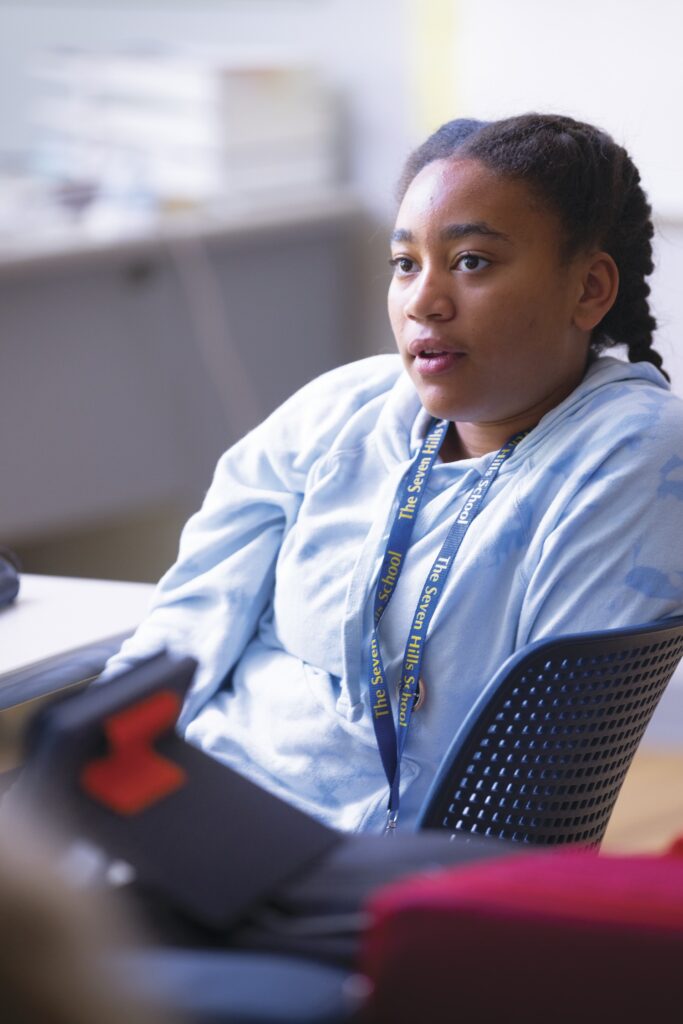
It’s not uncommon for the room to be moved to tears throughout the Real Talk. One panelist spoke of his experience having a stutter. “For him to come on stage and talk about stuttering to a crowd of 250 people, and to hear him stutter on stage, it’s not seen as something foreign,” says Waskowitz. “He didn’t use the word struggle, he said it’s a part of who I am, and we could hear that, literally and figuratively,”
For the LGBTQIA+ discussion, a panelist spoke of his journey of being transgender, transitioning throughout middle school and high school, and the mental health battles he fought.
The religion panel was a diverse representation of different beliefs, from a student who is an atheist to Waskowitz himself, who shared his experience being raised Jewish and then converting to Buddhism as an adult, reflecting how it is OK to not stick to what you were raised.
A particularly powerful Real Talk was the discussion on mental health. “We had a student who fought a lot of uphill battles in life,” says Suer. “He felt very alone, like he didn’t have friends. After the talk, he inspired the entire school with what he said.”
The list of stories shared on stage is endless. A student who is deaf shared about her cochlear implants, a student who discussed the impacts of her alopecia, another student that told her story of cerebral palsy—Seven Hills Middle School creates space for all students to be empowered by what makes them different.
“We’ve had nothing but positive feedback from our parents,” says Kalubi. At the start of the Real Talk series, she was nervous to propose the idea to the school board. “They were like, this is going to be risky, this is going to be uncomfortable,” says Kalubi. “But that’s the whole reason why we do this. To make people understand that it is okay to be unsure or unknown about differences.”
“We really feel it is important for our kids to understand the diversity that exists, to respect and value the differences that are in our community, and celebrate and embrace these differences,” says Waskowitz. “We’re always looking for what can empower kids to feel comfortable about who they are, because that’s what it’s about during the beginning, middle and end of the day.”
The school is consistently searching for new topics and ways to ensure that the voice of each student and faculty member in the community feels heard, seen, valued and appreciated. “Our mission as a school is all about creating compassionate engaged citizens that have a powerful head and a powerful heart,” says Waskowitz. “We want to make sure that there’s something for everyone.”
