

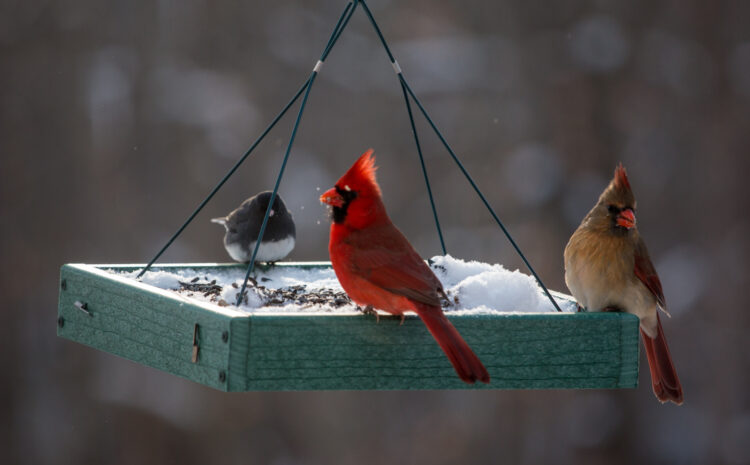
Feeders help provide food energy in a dead time of year
As we hit midwinter, with temperatures hovering at freezing or below for days in a row, you can find joy in becoming a backyard bird watcher—and feeder.
The U.S. Fish and Wildlife Service estimates that 59 million Americans feed their feathered friends for a chance to see, up close, cardinals, woodpeckers, blue jays, finches and many others.
If you’re not among them, it’s easy to join. Just hang a feeder in the backyard and fill it with bird seed. Make sure that it’s visible from a window where you can watch the birds gather and dine.
Some people go to their favorite big-box retailer to buy feeders, ranging from tubes to stylish hopper feeders in the form of houses, barns and other ornamental designs. If you want personal service and advice—such as how to keep squirrels and other uninvited guests out of your feeders—a number of smaller shops, with various bird feeders and bird baths and numerous birdseed options, can be found locally. Carmel, Indiana-based Wild Birds Unlimited stores are independently owned.
· Newtown Feed and Supply, 6876 Main St., Newtown.
· Wild Birds Unlimited, 6781 Harrison Ave., Green Township.
· Wild Birds Unlimited, 1192 W. Kemper Road, Forest Park.
· Wild Birds Unlimited, 9889 Montgomery Road, Montgomery.
· Wild Birds Unlimited, 7712 Voice of America Centre Drive, West Chester.
· Wild Birds Unlimited, 4987 Houston Road, Florence, Kentucky.
· Ed’s Feed & Seed, 12085 Montgomery Road, Symmes Township.
· BestNest.com, 4000 McMann Road, Union Township (no sales on-site; online only).
The University of Florida’s Institute of Food and Agricultural Sciences credits Henry David Thoreau with the earliest written account of wild-bird feeding—in 1845 at Walden Pond—and also says the first commercial bird feeder, for hummingbirds, was marketed in 1926.
“Bird feeders can be an important food source during winter,” Wild Birds Unlimited in Montgomery wrote last month in a social-media post. “When severe weather impacts wild food supplies, some species of birds will turn to feeders as a critical food resource. It is during these times that feeders play their most vital role.” It also said birds in an average environment typically forage about five hours a day to meet energy requirements, while in the winter, they might need to forage longer.
Bird enthusiasts regionally had a scare last summer when several species of birds were found to be sick or dying of an unidentified illness. Wildlife officials in Ohio, Kentucky and Indiana asked birders in May to remove feeders and bird baths while they investigated thousands of reports of birds coming down with neurological issues, including paralysis, as well as crusty eyes, swollen faces and an inability to fly. The ailments also were reported in Washington, D.C., Maryland, Virginia, West Virginia, Pennsylvania, Delaware and Tennessee.
Through various state laboratory tests, officials ruled out avian influenza, West Nile virus, salmonella, chlamydia and a host of other potential causes. In September, Ohio, Kentucky and Indiana gave the go-ahead to put feeders out again but to keep an eye out for sick birds. The source of the illness remains unknown. Some experts speculate that the 17-year Brood X cicadas last summer might have carried a fungus or have been contaminated with pesticides, and when the birds fed on them, they became sick. The timing of the illness occurred about the same time that the cicadas were out.
The Ohio Division of Wildlife said in September: “It is important to keep feeders clean: Use a 10% bleach solution (1 part bleach, 9 parts water), rinse and let dry at least once a week. Take a break (7-10 days) from feeding if you see sick or dead birds. This prevents birds from congregating and passing transmissible diseases.”
Just call it enforced social distancing of a different kind.
