

Startups are finding a home at CVG
Every day, more than 350 flights arrive and depart from the Greater Cincinnati airport, while more than 20,000 passengers board or disembark and make their way through the terminals to their homes, businesses or next destinations. They’re probably not aware that behind the scenes the airport has become a test site for startups in transportation, artificial intelligence, robotics and other innovations.
The airport has positioned itself as a “living laboratory” for new technologies, a city within a city where its 7,700 acres of land, 14,000 employees and sprawling infrastructure are available to field test nascent technologies, some of which could eventually be adopted by other airports and even by other industries.
“CVG is a strategy partner,” says Ritukar Vijay, the CEO of Ottonomy, a Santa Monica, California-based company that develops robotics.
The welcome sign for entrepreneurs has been noticed by startup founders who have relocated their young enterprises from more traditional hubs of innovation, including Silicon Valley, to the Cincinnati/Northern Kentucky International Airport’s environs.

Since 2018, the airport has employed a chief innovation officer, Brian Cobb, whose job it is to lead collaboration with potential suppliers, and further research and development. Airport leaders have identified four areas to support new advancements in technology: security, cleanliness and sanitation, mobility and transportation, and connecting passengers with real-time data.
The airport’s early adoption of technology actually began nearly 10 years ago with a product that used Bluetooth to monitor sales and service at retail concession outlets, Cobb says. That technology was adapted, along with Wi-Fi sensing, so airport employees can use it to monitor wait times at security checkpoints and adapt schedules and assignments to reduce those lines.
The airport has since collaborated with a variety of startups to connect passengers and employees with information they can use, enhance security and create more efficient housekeeping methods.
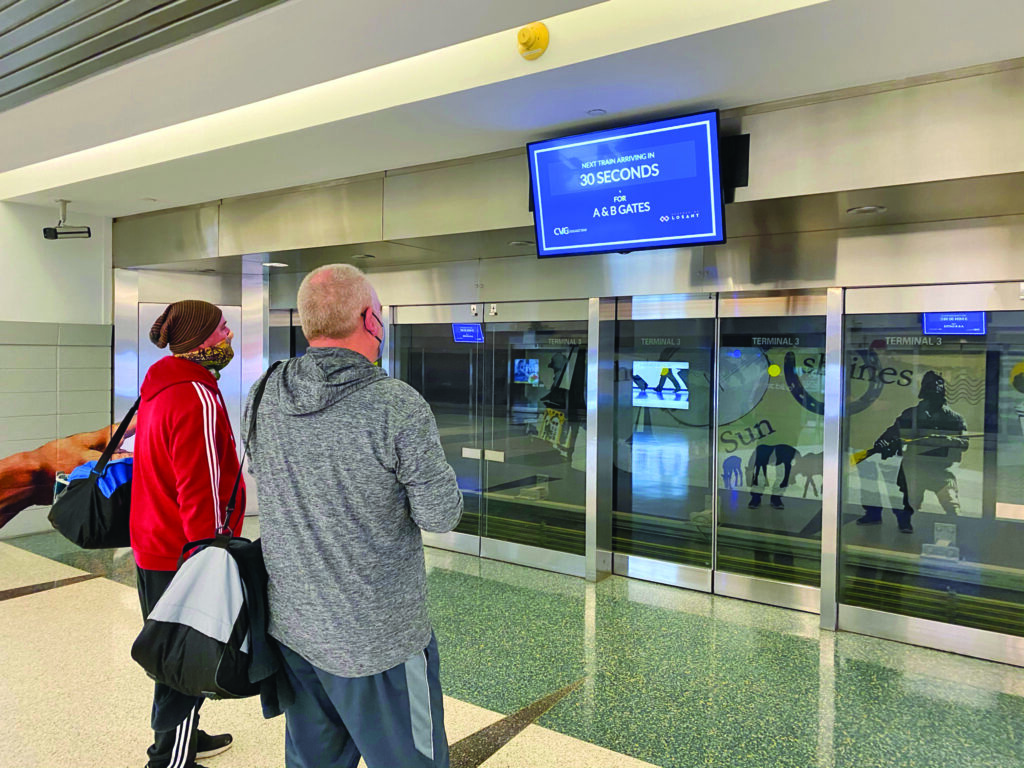
Among its partnerships is a collaboration with a Cincinnati-based company called Losant that provides software that tracks and communicates real-time data. At the airport, a Losant product tracked foot traffic through the restrooms and then transmitted that information to airport workers through a wearable device so they could clean the facilities based on usage and not simply on a routine schedule.
Another Cincinnati-based digital company called Differential has collaborated on a software platform called Ease that pulls data from different sources around the airport and displays it on a single dashboard so airport employees don’t need to monitor multiple data streams. That helps streamline decision making. “It helps predict what might happen based on the data we’re seeing and how we might create actions to solve problems that might come up before they come up,” says Sean McCosh, one of the company’s partners.
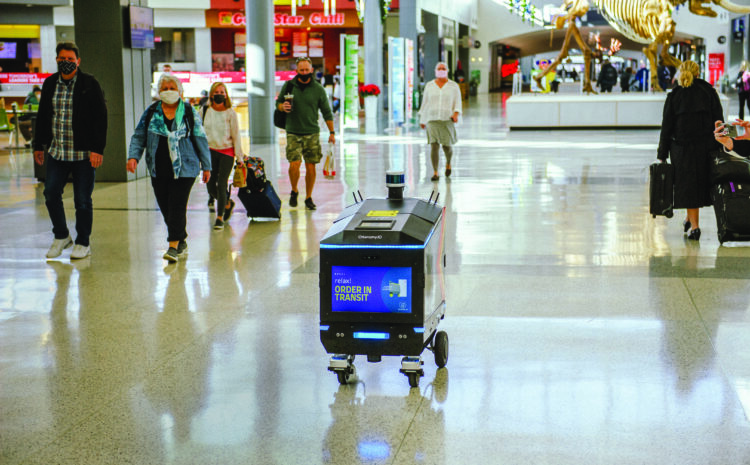
With a vast amount of space indoors that requires constant maintenance, upkeep and labor, robots have become a technology to test.
In 2020, just as the COVID-19 pandemic emerged, CVG became the first airport in the U.S. to use a floor-scrubbing robot developed by an Ontario, Canada-based company called Avidbots. “Introducing new technologies to elevate the passenger experience is critical to our business,” airport CEO Candace McGraw said at the time. “In the challenging and uncertain times we find ourselves, making sure our facilities are safe and clean is our top priority.”
In 2021, Ottonomy chose the airport to debut its robots that can deliver food to waiting passengers who order through their phones. “We are the world’s first to do autonomous deliveries at any airport,” says Vijay, the company’s founder as well as CEO. Passengers who may not want to leave their departure gates can order from a limited selection of food vendors and use a QR code to receive the delivery when it arrives.
Cobb says the airport’s willingness to test new products and technologies can lead to broader applications for those ideas and ultimately to financial gain for the airport.
“If it’s successful in aviation and it’s successful in a micro-city environment, what other industries could it possibly expand into?” he says. “Can we take that technology and sell it to other airports, to other aviation firms or even outside the industry? Then we have mutually developed a new stream of revenue for CVG.”
Other companies have located near the airport to capitalize on its growth as a cargo hub, and the presence at CVG of the world’s largest ecommerce carriers, Amazon and DHL.
One of those is Brightpick, whose employees have developed autonomous robots designed to work the floors of warehouses selecting and picking items for eventual delivery to consumers. Earlier this year, Brightpick, a company founded in Slovakia, moved its U.S. headquarters to Hebron, Kentucky, to be closer to the air hubs and to the interstates that provide quick access to much of the country.
“There’s a lot of accessibility to most of the country from Cincinnati, so there’s a tremendous amount of growth happening in Cincinnati in the ecommerce area,” says James Cox, Brightpick’s chief commercial officer. “So we felt that this is the best place to be.”
Brightpick is part of Photoneo Brightpick Group, a company that, in addition to developing warehouse robots, develops robot vision sensors and artificial intelligence software. In January, the company completed a $40 million round of investor funding, bringing its total capital raised since its inception to $53 million.
In May, Brightpick announced that its warehouse robots would be employed by e-commerce provider Netrush, whose Hebron warehouse is located about 10 minutes from the airport.
CVG also collaborates with area universities, perhaps most notably with Miami University in Oxford. Airport and university leaders reached an agreement in 2021 that calls for CVG to manage and operate Miami’s airport. The facility, located just west of the university in Butler County, is a small, general aviation airport that supports corporate flights, flight training and recreational flights. Under CVG management, it will also be a test ground for aviation-related innovations, as the agreement emerged out of several years of collaboration between CVG and the university.
“We believe that, over time, this airport can serve as a laboratory for aviation innovation to the benefit of us at CVG, as well as the Miami community,” McGraw said when the agreement was announced. “Whether that be through learning experiences or testing the new and next in aviation.”
