

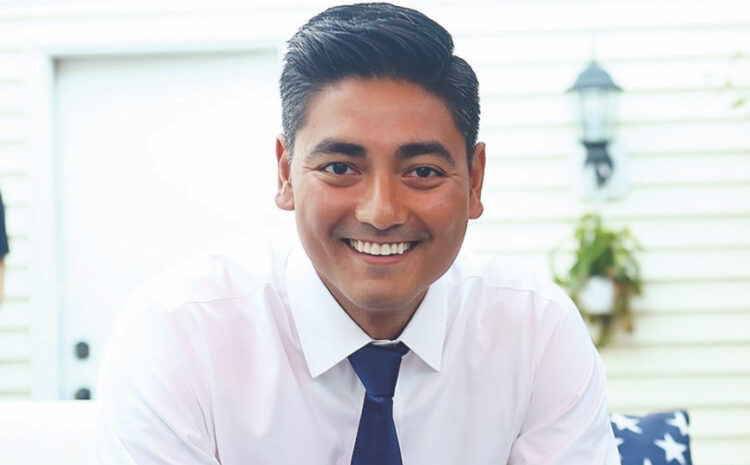
Aftab Pureval is running for mayor again, but his future afterward remains unclear
In March, Cincinnati Mayor Aftab Pureval made a very early announcement. Yes, he’s running again in 2025. No, he’s not taking an early exit ramp to the Biden Administration, despite rumors of an ambassadorship or a deputy secretary job.
Aftab has all the traits for a bright political future: charismatic, smart, a positive and inclusive political style. But experience shows that prospects are limited for a former Democratic Cincinnati mayor.
Since the 1950s, the only former mayor to move onto higher Ohio office was Republican Ken Blackwell. Ken was mayor from 1979-80. Blackwell was elected state treasurer in 1994 and secretary of state in 1998. He lost a race for governor in 2006, the last time the GOP lost that office.
Several former Cincy mayors have been elected to Congress—Don Clancy (mayor from 1957-60), Willis Gradison (1971-73), Tom Luken (1971-72), his son Charlie (Cincinnati’s longest serving Mayor, from 1984-90 and again from 1999-2005) and Dave Mann (1991). But other than Republican Ken Blackwell, no Cincinnati mayor since 1950 has moved up to statewide office.
That record was not for lack of trying.
Jerry Springer (1977-78) ran for governor in 1982, but lost the Democratic primary to Dick Celeste. While his political career hit a cul-de-sac after, it mutated into something far more conspicuous than elective office. Can you think of any local politician with an opera named after them?
More recently John Cranley (2013-22) crashed and burned in the 2022 Democratic governor primary, clobbered by former Dayton Mayor Nan Whaley, who in turn was buried in November by Mike DeWine.
And while former and longest serving Mayor Charlie Luken never sought state office after his second stint as mayor, he failed in a subsequent run for Hamilton County Probate Court. Ouch.
In contrast, many Cincinnati mayors were content to fade away, channeling the legendary Cincinnatus, our city’s namesake, the former Roman general who had the good sense to retire from politics after a big military triumph. Among that prudently reticent category were Ted Berry, Cincinnati’s first Black mayor, 1972-75; Bobbie Sterne, 1975-76; Gene Ruehlmann, 1967-71; Tom Brush, 1982-83; Arn Bortz, 1983-84; Dwight Tillery, 1991-93; and Mark Mallory, 2006-13. Former Mayor Rozanne Qualls, 1993-99, did run for mayor again in 2013, losing to John Cranley. She has not sought elective office again.
So what has made Cincinnati mayor’s office such a political dead end? First, as Cincinnati and Hamilton County have turned bright blue, Ohio has become deep red, cramping statewide prospects for any Democrat. Former Democratic Cincinnati Councilman and County Commissioner David Pepper lost two statewide races in 2014 and 2018, learning that lesson the hard way from Ohio voters.
Second, in statewide primaries, Cincinnati Democrats suffer from their isolation in our corner of the state. The center of gravity for Ohio Democrats is farther north, along the Columbus-Cleveland corridor, where unions, ODP party activists and donors dominate the process of anointing up-and-coming party stars. So if ever Ohio loses its deep red tinge, any Cincinnati mayor is less likely to benefit.
Finally, urban mayors have tough jobs. Hard decisions must be made. Sleazy deals get cut. Reputations suffer. George Voinovich, former GOP Cleveland mayor, elected Ohio governor and senator in the 1990s, is the only “strong” big city mayor I can think of who escaped that curse.
So Aftab, where’s the path to your “bright” future? Maybe a bigger if temporary stage in some future Democratic presidential administration. Otherwise, have a back-up plan. There’s always a sketchy TV show. n
Don Mooney is an attorney, a past member of the Cincinnati Planning Commission and is active in local politics.

Another View By Don Mooney
