

Democrats hold 9 of 11 Hamilton County-wide offices in a total flip from 30 years ago
Just 30 years ago, the Republican Party controlled the Hamilton County political landscape.
Winning nine of 11 non-judicial countywide offices in 1992 and 1994, the GOP needed only the county auditor’s and county recorder’s offices for a sweep.
They won the recorder’s office in 1996, with Rebecca Groppe barely beating her Democratic opponent, current Cincinnati Board of Education member Eve Bolton. But the GOP never could defeat perennial Democratic Auditor Dusty Rhodes, a popular former AM radio disc jockey who ended his 32-year run as auditor this year.
Still, to paraphrase the Meat Loaf song, 10 out of 11 ain’t bad.
What a difference a generation makes.
In the past two elections for countywide offices—last year and in 2020—the Democratic Party has reigned supreme, flipping almost all of the 11 positions.
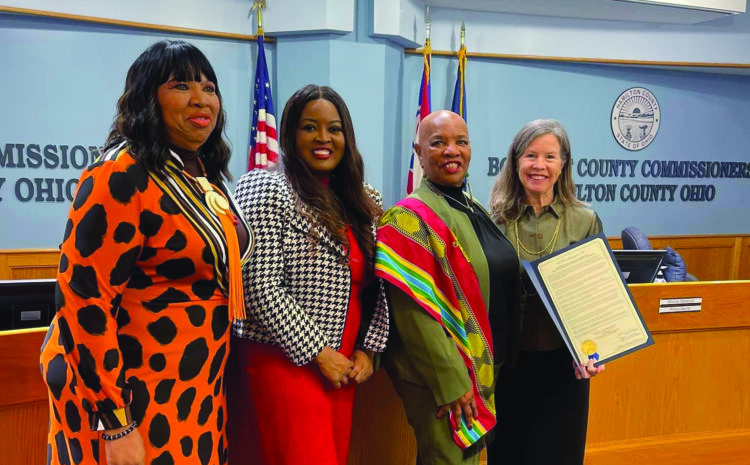
Democrats now occupy three commissioners’ chairs, the clerk of court’s office, the sheriff’s seat and the auditor’s, recorder’s, treasurer’s and coroner’s offices. That’s all but the prosecutor’s and engineer’s offices.
That leaves the Democrats ecstatic and the Republicans wondering what happened.
“We have done a lot of work in making sure we educate the county and not just the Democratic Party,” Gwen McFarlin, Hamilton County Democratic Party chairwoman, says. “That’s one of the things I learned when I first got into politics. It’s about the people, working people. It doesn’t matter who they are, where they come from. It’s about what’s important to them.”
McFarlin, who grew up on a farm in Clermont County, became a Springfield Township trustee in 1995, giving up her position 25 years later when she joined the Hamilton County Board of Elections. She and Connie Pillich, a former state representative, became the first women to co-chair the county’s Democratic Party in June 2018. They replaced Tim Burke, who led the party for 24 years. Pillich left for a job later that year, and McFarlin became the party’s sole leader.
“I get energy—and we get energy as a party—from the people that we are here to serve,” McFarlin says. “And also looking at things that are important, like the economy, voting rights, Civil Rights Act, social justice. We’ve always worked with working families and the middle class. I think what you’re seeing in this is so many folks are so sick and tired of the rhetoric that is so, so uncivil.”
Demographics also have changed in the past 30 years. Voters in the city of Cincinnati have been a reliable Democratic bloc overall through the years, but they have become even more so more recently, providing a solid blue hue to the middle of the county while farther west and farther east remain red.
A Democratic presidential candidate has won Hamilton County the past four election cycles; the four before were won by a Republican. Republican President Donald Trump, who won Ohio by eight percentage points over Democrat Hillary Clinton in 2016, lost Hamilton County 53%-42%, with the city of Cincinnati voting 75% in favor of Clinton. In 1996, Republican Bob Dole defeated incumbent Democratic President Bill Clinton in the county, 50%-43%, at the same time that Clinton took Ohio, 47%-41%, on his way to a second term (Ross Perot, a third-party candidate, received 11%).
Russell Mock, newly elected chairman of the Hamilton County Republican Party, knows his party has a hill to climb, and he’s ready to lead the charge.
“As Republicans, we need candidates that will appeal across the political spectrum,” Mock, who took the job in early February, says. “We need to be able to attract the women voters back to the party, and by focusing on what I consider the most important issues—the economy, public safety, limited government, education—and if we stick true to our conservative principles in those areas, I think we can attract people back.”

He noted that Republican Gov. Mike DeWine, who has governed mostly from the middle, especially during the COVID-19 pandemic, won Hamilton County last year as part of his re-election. The governor’s races since 1992 have been one bright spot for the county’s GOP, which has won all but one locally. Ironically, the loser was DeWine, who lost to Democrat Richard Cordray in 2018 but won statewide.
Mock himself was a victim of the Democratic surge. After serving as a county judge starting in 2004, he lost his First District Court of Appeals re-election race in 2020 to Democrat Ginger Bock.
The county’s chief Republican, a native of Mahoning County in northeast Ohio, replaced Alex Triantafilou, a lawyer and former judge who was selected as the state GOP chairman in January. Triantafilou served 15 years as county chairman.
How does Mock plan to bridge the gap with Democrats? He points to three initiatives:
– SHELeads, “a women-based leadership group that routinely gets together and discusses the issues. They bring those to the chairman’s attention coming from a woman’s perspective and also help recruit good-quality female candidates to run for office.”
– Black Rising Republican Club and Frederick Douglass Society, outreaches “to actively get into the community and have conversations with Black and Brown people about why it makes sense to be a Republican.”
– The Rising Republican Club, “which is young professionals, both men and women, getting involved in politics, most of them for the first time.”
Mock says “you hear a lot about demographics. I’ve lived here for almost 28 years now. I’ve seen the transformation. [Cincinnati] has attracted a lot of young people, and some of the older people, for whatever reason, have moved out of the county. We have a very highly educated demographic here.” Both groups are voting more Democratic.
The political sands are ever shifting, however.
Al Tuchfarber, a political science professor emeritus of the University of Cincinnati, has been following the change in demographics for decades. He also publishes a weekly analysis, Tuchfarber Report (tuchfarberreport.com).
“You have to think in terms of three geographics over time: the city of Cincinnati, Hamilton County and the total metro area, which is 15 counties,” he says. Cincinnati, whose population peaked in the 1950s at a half-million, was a Republican city from the Civil War until the 1980s, he says. Many Republican-leaning voters moved out of the city—which has a population today just above 300,000—and into suburbs in Hamilton County and beyond, into those regional counties, leaving the city, and even the county, more blue.
He points to a book, The Emerging Democratic Majority, published in 2002 by political experts John Judis and Ruy Teixeira, that pushed a strategy to build a majority based on professionals, women, minorities and 40% of the white working class through policy decisions, which worked through the Obama years.
That was a move away from the working class, which Tuchfarber says pollsters define as white, working-class income (skilled or semiskilled laborers) and no four-year college degree—about 25% of the voting population. “They have gone from 60-40 Democratic voters, over 20 years, to 70-30 Republican voters.”
It was a much larger shift than strategists anticipated.
Additionally, in the two most recent elections, minority voters—many among the working class—nationally have begun slowly moving toward Republicans, with Blacks voting 91%-8% Democratic in 2020 and 83%-14% in 2022 and Hispanics voting 63%-35% Democratic in 2020 and 56%-39% in 2022, according to data from AP VoteCast.
Those results—and the loss of the working-class vote—have sparked Judis and Teixeira in the past few years to sound an alarm about the Democratic coalition, especially the loss of the working class. Tuchfarber also notes that the white working class overlaps with white evangelicals, who are now voting 85%-15% Republican.
But as the saying goes, all politics is local. McFarlin says it’s all about the quality of candidates as she works to hold the majority of county offices.
“When we’re recruiting, we delete those who are unelectable,” she says. “I don’t care who your mother, father, sister, brother, auntie is, if you are not a person that is civil, that has the expertise to work together as a team and be a leader … that’s not gonna cut it.” She also wants candidates to have some sort of public service on their resumes—and integrity is everything for her, she says.
Mock, as the new guy, says he’s “doing a review from top to bottom and then bottom back up to the top” as he devises the minority party’s county strategy.
“I truly want to unify the party,” he says. “I think we can get back to winning races at the countywide level. We have to keep getting our message out there.”
He points to his home county as proof that things change.
“Mahoning County was blue forever—blue-collar union Democrats—and that county turned red.”
