

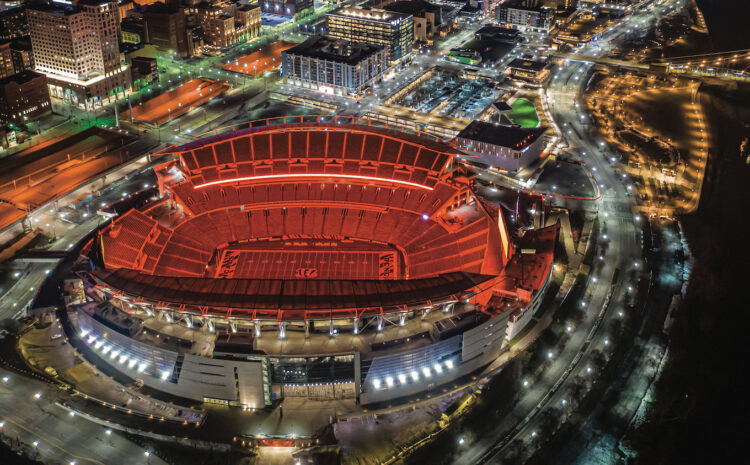
Bengals historic season is already benefitting the entire region
The Bengals might not have won the Super Bowl, but the businesses in our area sure did. And they will continue to benefit from our city’s participation for the foreseeable future, especially if you look at history of other medium market cities that have participated in the grand game.
While solid numbers on the actual economic impact of the Super Bowl are hard to track, according to most economic experts, most are also quick to add that the economic impact on our local businesses was profound. Indeed, many are now pointing to Cincinnati’s selection as a finalist as a host city of the 2026 FIFA World Cup (the announcement of which was a scant few days away as of press time) as being the result of the city’s participation in the Super Bowl. That could have a very dramatic economic impact as well. More on that later.
“It’s hard to quantify, but we know there’s a real effect,” says Jill P. Meyer, president and CEO of the Cincinnati USA Regional Chamber. “We also know that the Super Bowl run itself is not the end of the story. We look forward to more visitors to the region and more money being spent in the local economy throughout the year and into next season.”
With the announcement of the upcoming schedules for the NFL season last month, the expectation that the Bengals and the city of Cincinnati will receive a lot more attention from national media has been confirmed.
“The Bengals received the maximum number of primetime slots that the league allows for one team, not something we are used to around here” says Brandon Rudd, director of research and data at the Cincinnati USA Regional Chamber. “But this year, they will play in front of a primetime crowd five times, up from only one primetime game last year. This includes a Monday Night Football match up against the Buffalo Bills that may end up being the biggest matchup of the regular season. They’ll also be playing in more 4:25 p.m. games, which provides more viewers than the typical 1 p.m. time slot. So, we are very much still bullish on the exposure that this run will bring to the city in the long term.”

So the sports bars and hotels across the region should easily make significant business gains in the coming season, not to mention the sales of sports memorabilia at retail outlets.
While the Super Bowl capped off the successful 2021 Bengals campaign, business actually started to build much earlier in the season.
“This winning season has seemingly had a big jolt to our economy, inspiring fans to celebrate in new ways and support local businesses,” says Julie Calvert, CEO of the Cincinnati USA Convention & Visitors Bureau. “We’ve heard so many reports of increased sales from bars and restaurants, shops, bakeries and more. It was evident in the empty shelves at sports stores, lively downtown atmosphere on Sunday and even the cream cheese shortage!
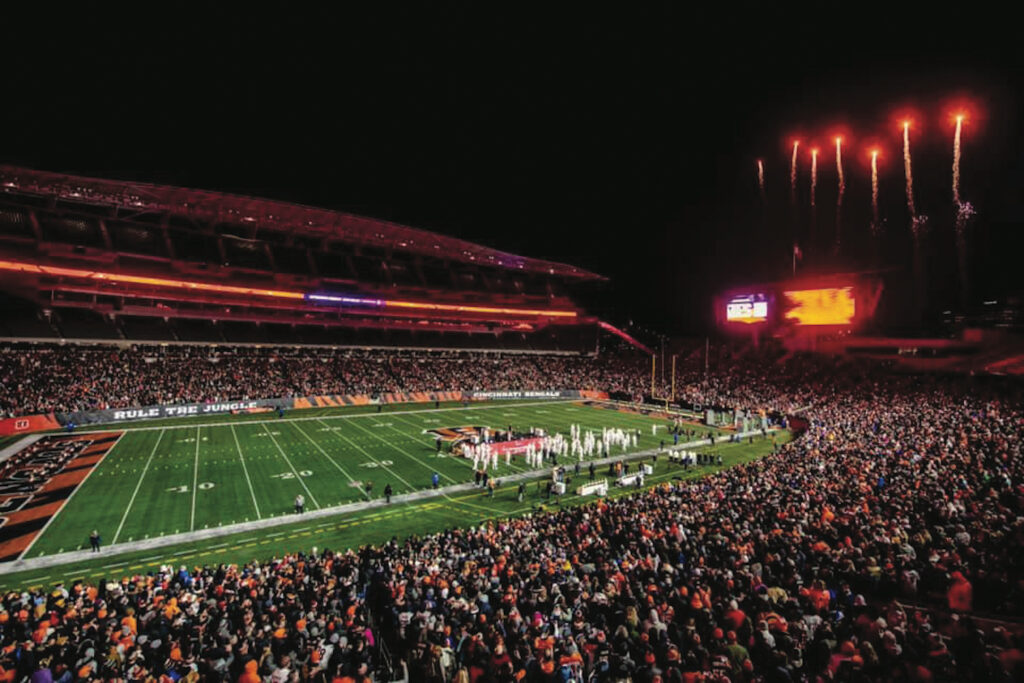
“Following the AFC Championship game, our team and meetNKY went right to work on a marketing campaign to invite people from a 200-mile radius to join us in Cincy to celebrate the Super Bowl together,” adds Calvert. “We listed as many watch parties and community events that we could find. Our website saw an increase in traffic 55% year over year, and more than 11,000 took action on our pages that outlined the local celebrations.
“While final reports are still coming in, anecdotally, we heard that many downtown hotels sold out on Sunday evening. Coming off the strong business on Saturday night for Valentine’s weekend, it was an important weekend for tourism, especially in a winter month.”
So what’s causing this business feeding frenzy across the Tristate area? Rudd has an idea.
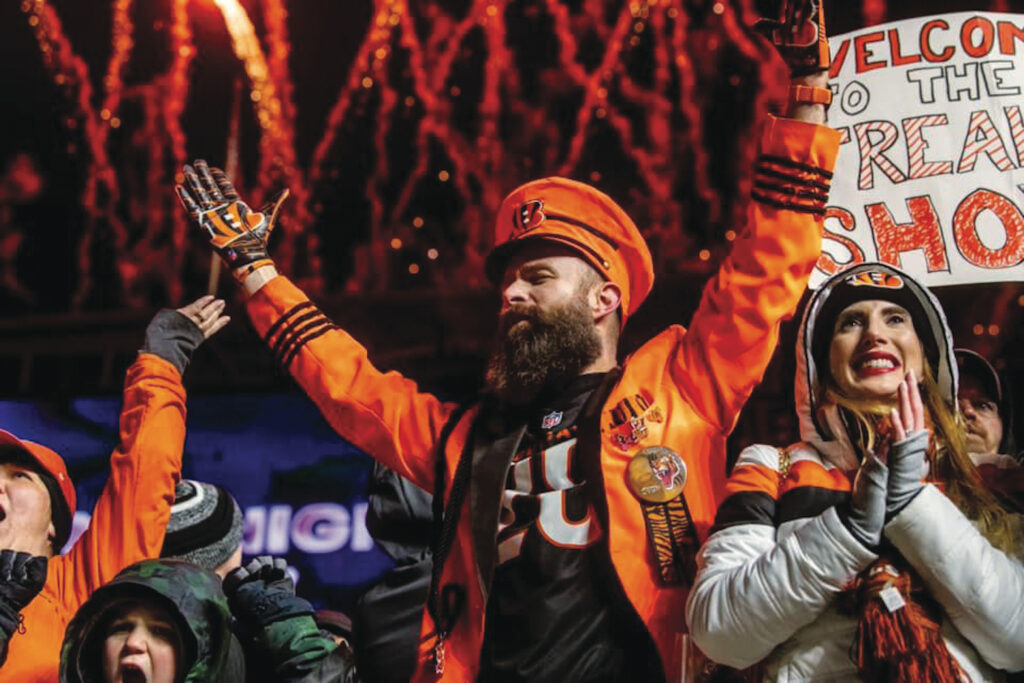
“We have been doing a lot of research on this topic and I have been looking at a lot of economic studies, especially from other mid-sized markets like Kansas City, Baltimore and Pittsburgh that have experienced economic impact from the success of their NFL teams,” Rudd says. “Some economists are using the term ‘psychic income’ for what happens.
“It identifies the concept that people, when their NFL or other sports teams do well, or if they are part of any group that is succeeding, actually feel better about themselves, and their emotional well-being goes up. When people feel better about themselves they feel wealthier and they spend more money. People go out to eat more. People spend more on clothing. People are just feeling good.”
If that sounds like promotional poppycock, think again.
Professors from the School of Economics and Management at Shanghai University of Sport and the Sheffield Business School, Sheffield Hallam University, confirmed the economic impact of “psychic income” on communities either participating in or hosting major sports events—the latter being especially true if the local residents were educated on the importance of such events. Using the Shanghai Tennis Masters as an example, the study found that “sports events are considered to have a significant impact on sustainable community development in the host country, especially economic, social and cultural development.”
So what will the bottom line look like when all the dust settles?
“It depends on which economist you talk to,” Rudd admits. “But I’ve seen several studies out there that use the figure of the Super Bowl adding an additional $100 of per capita income on the local economy from it.”
If you do the math, we have about 2.3 million people in the Greater Cincinnati region, so that’s well over $200 million in additional income.

“Now you look at the National Retail Federation statistics that indicate that on average people spend $89 on the event, whether that is for merchandise, food and drinks or decorations for their Super Bowl party—and obviously that number is much higher in cities that have a team participating,” says Rudd. “So we have estimated that there will be about $135 million spent in our area, just on watching the game alone.”
So now, previously published estimates of more than $460 million do not seem so far-fetched. Then you have to fold in the future economic impact that comes from the free marketing and impressions made on over 100 million viewers nationwide. When Kansas City was in the Super Bowl, Google searches for the city went through the roof.
Obviously, the timing of the interest couldn’t come at a better time.
“People absolutely have pent-up demand for travel, and we believe 2022 will boost Cincinnati into an even stronger position in our COVID business recovery,” says Calvert. “Leisure travel has been leading tourism recovery, and we’re confident that business travel will rebound more this year as well. Our city and county’s recent action to name 3CDC as the manager of a new Convention Center District development with a headquarter hotel, is also a huge step in the right direction for business and convention travel recovery.
“The Bengals success and gaining so many new fans is a boost to getting the Cincy region into the consideration set of travelers,” adds Calvert. “We’re excited to follow up with an all-new marketing campaign this spring and summer to inspire those trips.”
Anecdotally, in the week after the AFC Championship game, the CVB received eight leads for new conventions that all mentioned the Bengals.
“We have a real sense that people are rooting for Cincinnati—not only the Bengals, but for our region’s success,” adds Calvert.
“This is a new era for the Bengals, and the city is going to capitalize on it for years to come,” says Meyer. “Joe Burrow and his teammates are representing the best of our city, and I would think that businesses and citizens are going to lean into the message that was loud and clear: ‘It Is Us.’”
As for being named a 2026 FIFA World Cup Host City finalist, if our city is recognized, it could result in an economic windfall of nearly a half billion dollars, according to a new economic impact study commissioned by the 2026 Cincy Local Organizing Committee.
The study, conducted by the UC Economics Center, shows that hosting the 2026 FIFA World Cup would bring a combined total economic impact of $449.4 million dollars and 3,087 jobs with wages of approximately $129.2 million in the Cincinnati MSA representing 15 surrounding counties in southwest Ohio, southeast Indiana and northern Kentucky. The study also finds that approximately $20 million in tax revenue will be created for state and local governments with $15.4 million resulting from sales tax revenue.
Cincinnati is one of 16 U.S. cities vying to be a World Cup Host City for the 2026 international event at Paul Brown Stadium. The 2026 FIFA World Cup will be the first time that the expanded field of 48 teams will play in the World Cup, with 80 total matches, making it the largest in FIFA World Cup history.
Of the 16, 10 Host Cities will be chosen from the United States with the remaining Host Cities from Mexico and Canada. The official announcement was yet to be made, as of press time.
“This report leaves no doubt that hosting FIFA World Cup matches will have an unprecedented economic impact on our region,” says Gary Lindgren, president of the Cincinnati Business Committee and Cincinnati Regional Business Committee. “Serving as a host city will result in close to a half billion dollars in economic impact, thousands of new jobs and tens of millions in tax revenue for our states, counties and cities in our MSA. This is one of the key reasons why our region’s business, civic and government leadership has rallied to whole-heartedly support this bid.”
The study, which used a schedule of four matches hosted at Paul Brown Stadium as a reference since the 2026 schedule is not currently known, estimates that 267,384 fans will attend the four matches at Paul Brown Stadium. These visitors are expected to spend $305.20 per day for food, drink, retail, lodging and transportation over an average of four nights, resulting in an economic impact of $195.3 million dollars for Greater Cincinnati. Estimates show that Hamilton County will realize nearly $4 million in tax revenue while the state of Ohio will see nearly $7 million.
“When companies are considering expansion, opening businesses or relocating headquarters, or entrepreneurs are looking for a place to land, we want them to think Cincinnati is the place to be for them,” adds Kimm Lauterbach, president and CEO of REDI Cincinnati.
