

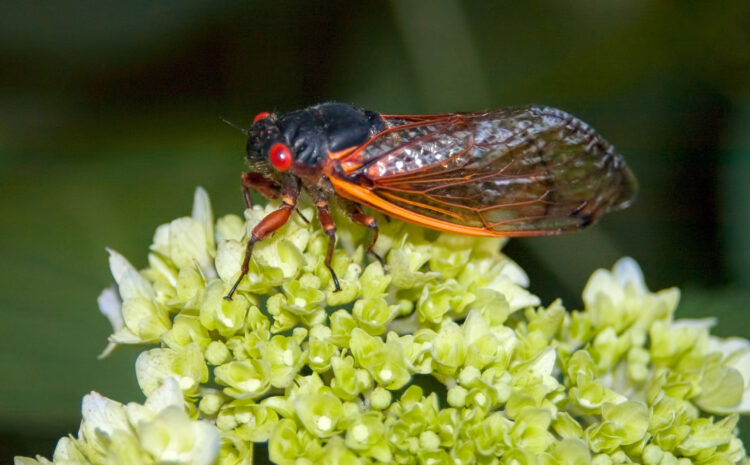
17-year cycle of cicadas promises plenty of noise in next couple of months
17 years underground. 17 years of quiet. 17 years of, well, no sex.
Now, it’s about time for Brood X, the 17-year cycle of cicadas in the Midwest to the East, to emerge from the depths of the soil.
Brood X (and that’s pronounced Brood 10, not X) is expected to make its presence known in 15 states and the District of Columbia this year:
· Delaware
· Georgia
· Illinois
· Indiana
· Kentucky
· Maryland
· Michigan
· New Jersey
· New York
· North Carolina
· Ohio
· Pennsylvania
· Tennessee
· Virginia
· West Virginia
The bugs are not dangerous. Mostly, they are annoying by taking short flights and running into people and anything else in their way. They do not bite or sting.
They can be loud, however, in their breeding calls.
Gene Kritsky, Ph.D., the dean of the School of Behavioral and Natural Sciences at Mount St. Joseph University in Delhi Township, said in an interview with Alie Ward on her “Ologies” podcast in March that he’s measured cicadas as loud as 96 decibels—about as loud as a gasoline-power lawn mower or food processor.
Kritsky is considered an expert on all-things cicadas. He joined the Mount St. Joe faculty in 1983 and teaches a number of biology, entomology, evolution, marine biology and dinosaur biology courses. He has been quoted extensively after giving hundreds of media interviews, and writing or editing 10 books and more than 250 papers—including his newest book, “Periodical Cicadas: the Brood X Edition” for the Ohio Biological Survey.

Cicadas start emerging when the soil temperature hits 64 degrees eight inches underground. In Greater Cincinnati, that’s typically mid-May, so they’re expected just about any time now.
After emergence, large numbers of males congregate in trees, and start calling, and females begin to fly in.
“It’s like a gigantic cicada singles bar with a lot of competition,” Kritsky told Ward.
After mating, the males will die, and then the females look for a place to lay their eggs. She has a central rod in her abdomen, with two serrated structures that move opposite of each other and cut into the woody plants where she will lay her eggs. Females average 506 eggs, Kritsky said.
Then the female drops dead, and the eggs start hatching within six to eight weeks. They fall from the trees onto the ground and must quickly find a crack in the soil to move into and survive for the next 17 years. If they cannot move fast enough, they become food for ants, spiders, beetles and other predators.
Kritsky told Ward that the nymphs “feed on grass roots for the first few weeks, and by New Year’s Day, they’re 10-12 inches below the surface, latched onto a tree root, sucking.” And he knows, he said, because he has dug them out on New Year’s Day.
Mount St. Joseph University in April released an app named Cicada Safari, which allows users to search, photograph, video and help map the cicadas this year, which likely will remain for six to eight weeks.
“As strange as it may sound, periodical cicada broods can go extinct,” Kritsky said in releasing the app. “Brood XI, which emerged in large numbers just two centuries ago, was deemed extinct in 1954. This is true citizen science. People can use their phones with our app to track, photograph and help us map the cicadas to verify where they are emerging.”
Want to become part of the cicada research? The app is available in the Apple App and Google Play stores.