

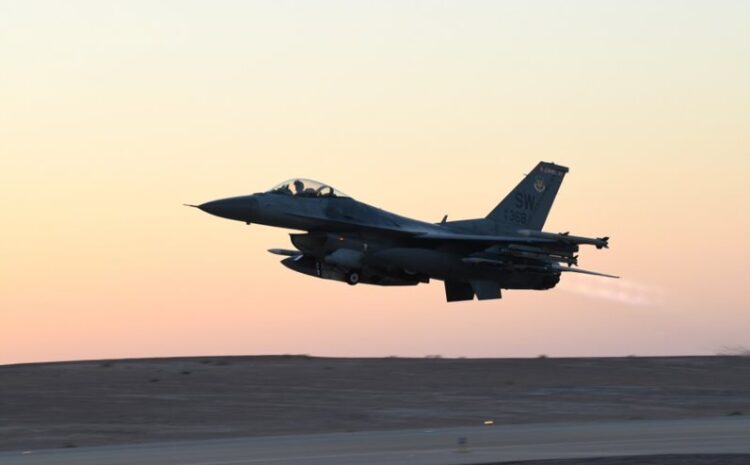
SW Ohio will make aviation and aerospace history for years to come
From two brothers tinkering in a bicycle shop in Dayton to a Wapakoneta native stepping out on the surface of the moon, Ohio has a storied past when it comes to flight and space. It is already the envy of other states in the nation.
But with the emergence of Cincinnati/Northern Kentucky International Airport (CVG) as the seventh largest cargo hub in North America, the unique public/private partnership of GE Aviation and Wright-Patterson Air Force Base in Dayton, and the emergence of more than 150 innovative companies in the region, Southwest Ohio is still making aviation/aerospace history.
“The Cincinnati region is quickly becoming one of the most globally connected in the country thanks to the leaders in our region and the presence of leaders like Amazon Prime Air, DHL and GE Aviation as well as the Wright Patterson Air Force Base just up Interstate 75 in Dayton,” says Kimm Lauterbach, president and CEO of REDI Cincinnati. “It is because of these leaders and companies that PwC (PricewaterhouseCoopers) ranked Ohio second for aerospace attractiveness in the country. Very few regions measure up to the Cincinnati region’s aerospace ecosystem, where more than 150 aerospace companies do business.”
The obvious synergies between Wright-Patterson Air Force Base and GE Aviation have made the Cincinnati region one of the most desirable locations in the country for aerospace companies, adds Lauterbach. The two combine to create a corridor of aerospace activity that runs along I-75 and represents one of the highest concentrations of aerospace talent in the country.
“The size of the Cincinnati region’s aerospace workforce makes it an easy choice for companies looking to grow,” Lauterbach says. “For example, the region is home to 2.87 times more aerospace engineers than the national average.”
According to REDI Cincinnati’s MSA Aerospace Industry Snapshot, there are more than 152 business locations supporting more than 17,285 industry workers. Growth in jobs has been 12.6% between 2015 and 2020, providing the Cincinnati MSA with $5.85 billion in Gross Regional Product. In addition to GE Aviation, other notable players in the industry include Barnes Aerospace, Jet Machine, Magellan Aerospace and Veelo Technologies among many others.
As the seventh largest cargo airport in North America, CVG has a profound impact on our region’s local economy as well, handling more than 1.2 million tons of cargo in 2019, growing 53% since 2016. As of August 2020, cargo had increased 13.4% over 2019.
Home to an Amazon Air Hub and a DHL Express Global Superhub, CVG’s has an annual impact of more than $6.8 billion on the regional economy. In addition to more than 14,500 badged employees, the airport is also working with more than 70 employers on its campus in need of talent, coordinating its efforts with local educational institutions to create a vibrant workforce community. All this while handling more than 9.1 million passengers annually.
According to Lauterbach, CVG’s growth, “is already driving growth in manufacturing, logistics and tech. The presence of Amazon Prime Air and DHL will help the region lead in transportation technology and our aerospace strength will undoubtedly play a role in that growth.”
High Flying with Deep Roots
The long history of aerospace manufacturing and development in Greater Cincinnati can’t be overlooked.
“Ohio is famously the birthplace of aviation, and one of the key reasons GE Aviation came to Cincinnati in the late 1940s was because of its manufacturing expertise and deep talent pool,” says William “Cole” Massie, GE Aviation spokesperson. “It’s a generational industry, and many GE Aviation employees have family members that inspired them to join the industry. That rich history across the entire industry helped create a robust aerospace ecosystem here locally.”
While the COVID-19 pandemic has hit the entire aerospace industry hard around the globe, and its impact has been felt here, “Greater Cincinnati will remain an outstanding home for us,” says Massie. “We have many local suppliers we’ve worked with for decades, we have a major hub for air transport at CVG and we have Wright-Patterson Air Force Base all within 50 miles of our global headquarters in Evendale.”
Wright-Patterson is integral to GE’s military development programs. In addition to the competitive programs that the company responds to, GE partners with the Air Force Life Cycle Management Center (AFLMC) and Air Force Research Laboratory to help develop new capabilities and improve existing products.
“We have many representatives on various consortiums and industry committees that share information with the US Air Force, which is mutually beneficial to the US Air Force and GE,” says Massie. “Wright-Patterson’s proximity allows our military business leaders to meet on short notice, have face-to-face conversations, and ultimately leads to productive relationships between our teams and Wright-Patterson personnel.”
“At the Air Force Life Cycle Management Center, our mission is to acquire and support war winning capabilities,” says Daryl Mayer, who is with AFLMC Public Affairs team at Wright-Patterson. “That means nearly every aircraft, bomb, uniform, helmet, vehicle, radar ready for war today is in the field because the men and women of this center put it there. We like to say, ‘If Airmen fly it, fuel it, transport it, drive it, eat it, wear it, communicate with it or drop it on targets— AFLCMC provides it.’
“This leads us to work with large traditional aerospace companies, like GE Aviation in Evendale, or purchasing the new F-15EX from Boeing in St. Louis or looking to non-traditional companies for an innovative bladder relief system for female pilots in fighter aircraft.”
Spreading Wings on Innovation
Sometimes flying a combat mission is not just about getting to the target. If you have ever taken a road trip of more than 300 miles, you know what long interrupted travel can do to your bladder. Now imagine flying 8- to 10-hour combat missions strapped to an ejection seat.
In an effort to find effective bladder relief for its female fighter pilots and combat aircrew, which have served in that capacity since 1993, the Agile Combat Support Directorate’s Human Systems Division in partnership with AFWERX, recently hosted something it called the “Sky High Relief challenge.”
AFWERX is a U.S. Air Force program with the goal of fostering a culture of innovation. It encompasses a number of programs and initiatives designed to circumvent bureaucracy and engage new business entrepreneurs in Air Force programs.
During its recent challenge 56 companies showcased their bladder relief solutions, to include entirely new systems, along with parts that could be paired with commercially available products. Of those companies, the government awarded 10 prize challenges of approximately $100,000 each for components, and one prize challenge of $250,000 for a full system. Now, the companies will be given the opportunity to advance to the second phase of the competition in order to respond to a Request for Prototype Proposal.
In total, $1,500,000 in cash prizes were awarded.
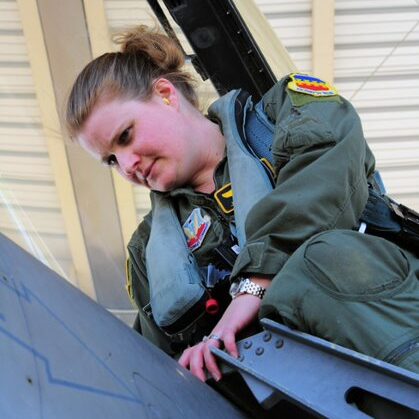
“This effort is important because right now, female aircrew lack effective options to relieve themselves in flight,” says 2nd Lt. Erika Cardinale, a program manager in the division’s Aircrew Performance Branch. “A number of them tactically dehydrate themselves [to avoid the need to relieve themselves in flight], and that can really affect their tolerance for g-forces, and physical and cognitive ability to fly and complete their mission. So we are looking to provide our female pilots more [bladder relief] options. The more we can give them, the better.”
“Our pilots do all of these sorties and missions, and yet one of the biggest fights they have is trying to use the restroom, because the devices they have are not sufficient and are leaving many with health concerns,” adds 1st Lt. Stevan Bacchus-Grant, Aircrew Performance Program manager. “So we are looking for solutions that are suitable, comfortable and feasible for our female aircrew members.”
The division plans to send the 11 companies a Request for Prototype, which will have specific guidelines for the remaining part of the competition. But the innovation fostered at Wright-Patterson doesn’t necessarily need to have defense applications.
“Our impact on the aviation industry sometimes crosses in the commercial market,” says Mayer. “A case in point is our recent investments in three companies that are exploring supersonic transport.
“Clearly, the primary use of supersonic technology is in the commercial market, but our Presidential and Executive Airlift team made investments to potentially benefit their mission portfolio or perhaps another military application.”
Brig. Gen. Ryan Britton, program executive officer for Presidential and Executive Airlift, sat with Mayer recently to discuss the future of supersonic transport.
Always looking for new capabilities, AFLCMC’s Presidential and Executive Airlift team is partnering with leading aviation companies to explore the possibility of supersonic travel. The idea came about while exploring potential future requirements in executive travel and learning about burgeoning interest in supersonic travel within private business in the United States.
“We were able to identify several opportunities where we could use small business money with some investments from my portfolio to begin to seed these opportunities for supersonic travel,” Britton says.
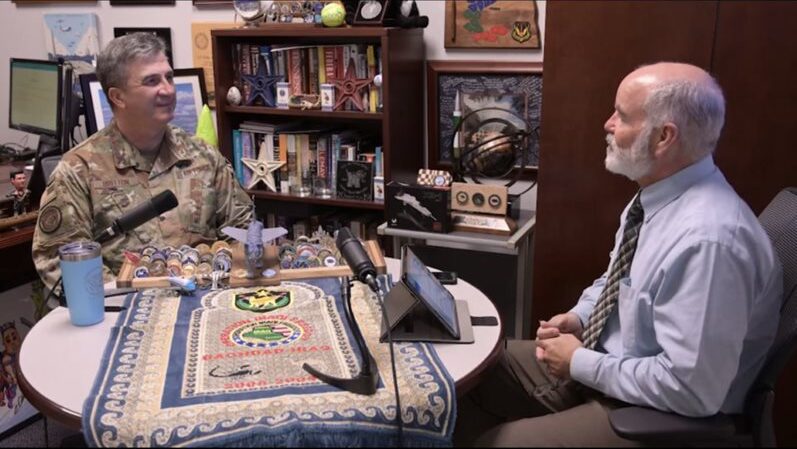
“From an Air Force perspective, we would never holistically invest in commercial transport for executive airlift to fly supersonic and do it all ourselves. But if we can pair our investments with what private investors are doing, well then you have a 10-15 fold increase in the amount of money available to actually do something that could change the way we do business for executives or military teams,” he says.
From a modest $4.5 million Air Force investment teamed with millions more in private investment, the team is looking to make some huge strides in the near future toward proving out supersonic capability.
“That’s a huge payoff if we are able to make this happen not only for the DOD, but specifically to build the industrial base for the nation,” he says.
Beyond learning about new materials, new engine technology and benefits resulting from research, there could be benefits in military strike or reconnaissance missions as well, he says.
But those aren’t the only ways the Airbase contributes to the local aviation and aerospace industry, Mayer notes.
“The Rapid Sustainment Office identifies emerging technologies such as artificial intelligence, advanced manufacturing or robotics to name a few,” he says. “The RSO looks to validate them through rapid prototyping and deploys and scales the technology over time.”
Indeed, last October the RSO hosted an Advanced Manufacturing Olympics as a virtual conference to connect with leaders in government, academia, industry, startups and tech companies and others.
Filling the Talent Pipeline
While Cincinnati’s aviation heritage is important to major companies like GE Aviation, maintaining a talent pipeline to supply it with tomorrow’s engineers and innovators is equally important, says Massie. Greater Cincinnati produces outstanding talent from local colleges, universities and trade schools.
“With UC, Xavier, Dayton, Miami and Ohio State, and Cincinnati State, there are strong undergraduate, graduate and trade programs that equip students with the skills necessary to build aerospace careers at GE,” Massie says. “We welcome hundreds of interns, co-ops and trainees from these programs each year to explore careers in aerospace and get valuable hands-on experience in the industry. Those experiences often translate to full-time roles with the company and help early career employees hit the ground running.”
Massie offered three examples of strong education partnerships. The first is the Xavier Student Veterans Center. Over the last six years, GE Aviation has donated $3 million to the center to help build and develop Xavier into a school of choice for student veterans.
“Xavier announced a scholarship in honor of former GE Aviation President and CEO David Joyce last summer,” Massie adds. “And the first scholarships will be awarded in the fall semester.”
The company also has something called the GE Aviation Edison Engineering Development Program (EEDP) where members work full-time at GE while working toward a master’s degree. Many program members based in Cincinnati choose to pursue that advanced degree through the University of Cincinnati.
“We have a long-standing relationship with Cincinnati Public Schools, as well as other local districts, that involves employees tutoring and mentoring students, as well as introducing students to STEM careers,” Massie adds. “While COVID-19 has canceled in-person visits to schools, many of our volunteers have shifted their education programs to virtual activities. Our GE Volunteers look forward to when they can get back into the classrooms.”
And continue their education efforts for the next generation of our region’s innovators, engineers and entrepreneurs who are sure to make history in the decades ahead.
