

Brianna Matzke adapts the latest Response Project to bring new music into a COVID-19 world
As Brianna Matzke began brainstorming for the 2020 edition of her Response Project, she already knew she had her work cut out for her. The Response Project, you see, is all about “new” music.
By “new” music, I don’t mean rap or pop. I’m talking about “serious” new music. Some people refer to it as new classical music, though, strictly speaking, that’s not accurate. It’s a handy catchall, though, for a realm of music so broad and so varied that any one is doomed to failure. Sometimes, you see, new music is dissonant. Other times, it’s lush and traditionally harmonic. It can be filled with out-of-the-ordinary rhythms. Or electronic cacophony. Or dozens of other qualities.
What it is not, though, is easily marketable. It’s “new,” after all. People aren’t familiar with it. And unless you have a massive advertising campaign behind it—think Taylor Swift or Justin Bieber, for instance—people are unlikely to flock to download it.
But Matzke, a pianist and faculty member at Wilmington College, knew what she was getting into. She’s staged three different versions of the Response Project, beginning in 2015. Though the multi-performance projects are incredibly complex, the idea behind them is simple. She asks artists—composers, filmmakers, visual artists and others—to offer up a response to a particular piece of music or a phrase.
The first Response Project, in 2015, presented five pieces of music created in response to German composer Karlheinz Stockhausen’s “Mikrophonie.” Two years later, the theme was two words: “on behalf.” Then, in 2018, Matzke asked her collaborators to respond to Bob Dylan’s 1965 album Highway 61 Revisited.
The programming was adventurous and, in many cases, ventured into areas of music that few people had expected. And Matzke was delighted.
Back in 2013, she’d been wowed by what she heard during MusicNOW, a festival of new music curated by Cincinnati-born composer Bryce Dessner, a member of The National.
“I didn’t know that music-making like that was possible,” says Matzke. It’s not that she hadn’t ever come in contact with new music before. There was plenty of it in music school. “But I didn’t see how that music could ever possibly connect to the larger community.”
But MusicNOW did. Held in Memorial Hall, those performances were packed as they featured everything from Irish singer-songwriter Glen Hansard and minimalist composer Steve Reich to a group of Malian musicians named Tinariwen.
“MusicNOW purposefully thumbed its nose at genres,” says Matzke. “I loved that. It felt like completely me. I’ve never liked being pigeonholed. The music I listen to is not just classical music. It’s not just anything. My iPod is always on shuffle.”
This year’s compositional challenge was to respond to a collection of works by American composer Pauline Oliveros entitled “Sonic Meditations.” Oliveros was interested in music, of course. But she was also interested in how the space where a composition is played alters the sound and the impact the music has on listeners.
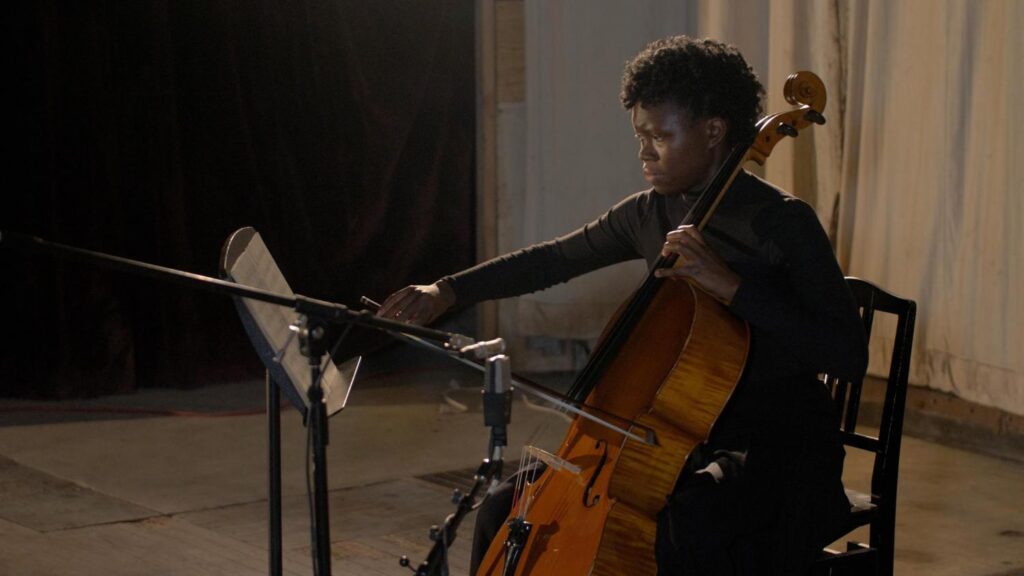
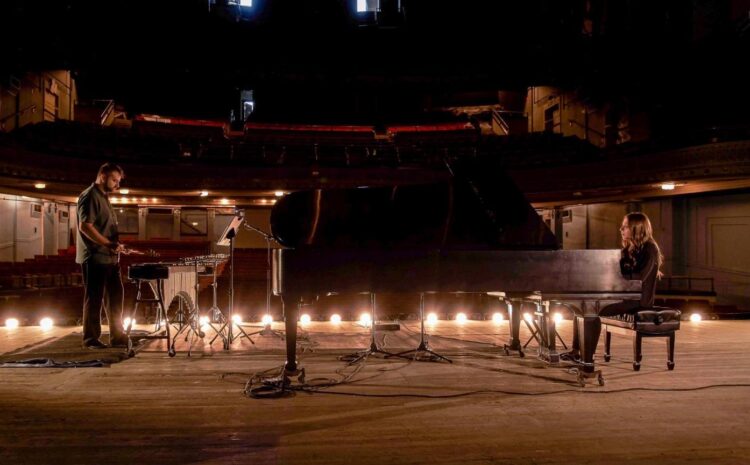
As usual, Matzke’s goal was to commission new works. But then she wanted to perform those works in different venues in Cincinnati. Specifically, she wanted to put her musicians in places that had great significance in the culture of Cincinnati and then invite audiences in to hear them.
Then 2020 happened. Pandemic, lockdowns, an ever-changing roster of safety protocols. For most people, all bets would be off. But despite her unassuming demeanor, Matzke is persistent. Perhaps stubborn is an even better word. Perhaps she thought about canceling. But if so, she won’t admit to it. For her, it was a matter of retrenching and finding a new way to present the Response Project.
She quickly recruited her friend, filmmaker Biz Young. In turn, Young recruited a pair of film and video professionals to work with her—audio engineer Jason Nix and producer Andy Gasper. Together, they reshaped the Response Project into an audio/video/musical adventure unfolding in locations that have helped to define the soul of Cincinnati during the past century.
Matzke is still negotiating the contract for one of the locations. But the other three, where films have already been shot, are the Emery Theatre, once the home of the Cincinnati Symphony Orchestra, but underused and poorly cared for during the past 30 years; the Imperial Theatre in the Mohawk District of Over-the-Rhine; and brewery tunnels under the Christian Moerlein Malthouse.
“Each one of the locations lent an interesting tonal quality to the sound,” says Nix. “And that meant [we] had to experiment a little bit to effectively capture the musicians as well as the distinctive sound of the space where we were recording.”
It wasn’t always easy. There was no way the audio arrangement in the brewery tunnels could be duplicated in the Emery. At the Imperial, there were street noises, as well. The building is located at a busy intersection where Linn Street dead-ends into W. McMicken Avenue.
“But the street noise was great,” says Young. “Usually, when you’re recording music, you’d want to make those sounds disappear. But these films we’re making are as much about the architecture and the neighborhoods around them as they are about the music itself.”
None of this is precisely what Matzke had in mind when she first envisioned the 2020 Project.
“But that’s fine,” says Matzke. “Just like we’re asking our audiences to have an open mind, we had to have an open mind as we embarked on this. We had no idea how it would turn out. But it has all gone so well. Better than I even imagined. “
It is, says Matzke, the sort of professional undertaking that she treasures.
“I get to ask multiple artists to create in response to something else that is out there,” she says. “What happens is this totally organic musical conversation. I’m not really in control of it at all. I care less about my own creativity that I do about being a chemist with other people’s creativity. I just love mixing other artists together and seeing what comes out.”
