


StartupCincy celebrates 10 years
When people think of commerce and innovation in Cincinnati, they may think of the city’s history of industry and large corporations. While the meatpackers and companies like Procter and Gamble may have built a city with a business impact that outpaces it size, Cincinnati’s next chapter is being written by entrepreneurs.
At the center of that evolution is StartupCincy, an initiative designed to amplify the region’s startup ecosystem. Celebrating 10 years this year, StartupCincy and its parent company, Cintrifuse, operate with a mission to drive innovation and economic growth in the region.
For J.B. Kropp, CEO of Cintrifuse and managing director of its investment arm, this mission is something perhaps a bit simpler—make Cincinnati one of the best places in the Midwest to start and scale a company.
“We like to think of StartupCincy as the front door,” Kropp says. “It’s where founders, investors, corporations and talent can all connect. It’s about making the ecosystem easier to navigate and, ultimately, easier to grow within.”
While Cincinnati’s entrepreneurial identity may feel new, its foundation has been quietly built over more than a decade. Kropp traces much of that back to early efforts from corporate and civic leaders rethinking how innovation could thrive in the city. The answer, in part, was infrastructure, both physical and cultural. The creation of Union Hall in Over-the-Rhine, alongside a broader StartupCincy identity, gave the ecosystem a central hub. “None of this happens overnight,” Kropp says. “It’s taken 10 or 11 years of laying the groundwork: building relationships, building trust, building capital.”
Today, the results are tangible, with more startups than ever before. Kropp notes that Cincinnati’s ecosystem is “healthier than it’s ever been.” Unlike coastal tech hubs, Cincinnati’s advantage is its accessibility, according to Kropp. The city’s corporate background creates a unique environment where startups can quickly connect with potential partners, customers and investors. “If you want to talk to someone at a major company here, that’s often one phone call away,” Kropp says. “That level of access is a real advantage.”
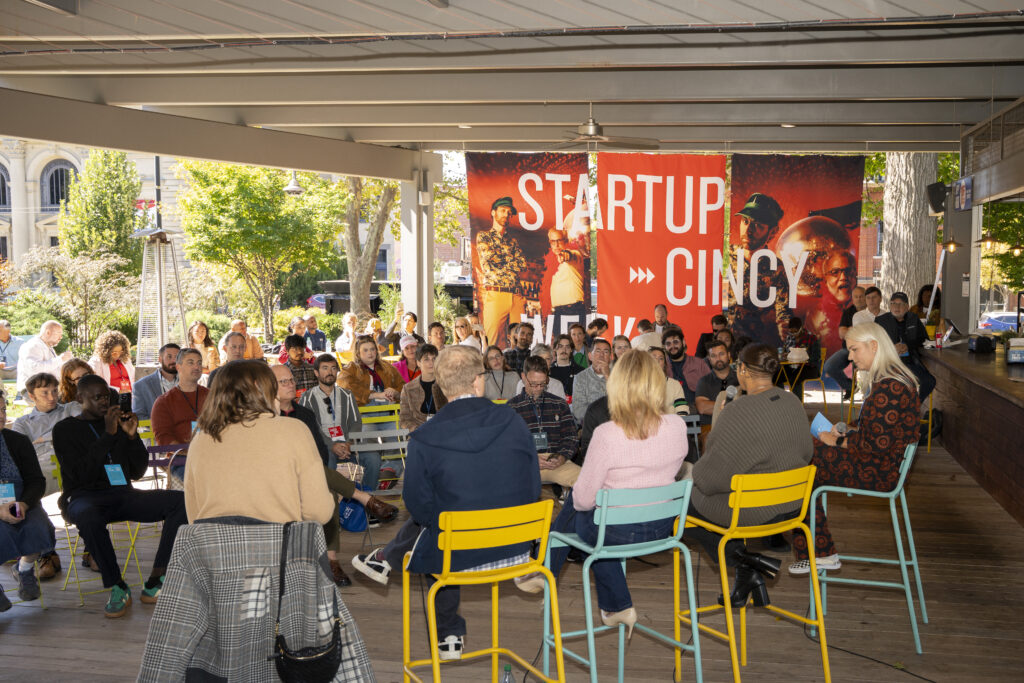
According to Kropp, that kind of support system is intentional. If capital and corporate access are critical, he hopes to provide community. Entrepreneurship can be isolating, he says. Founders often operate without a clear roadmap.
“Cintrifuse came in as one of our earliest investors and believers, connecting us with the right people and opportunities from day one,” says Chris Lee, co-founder and CEO of Airtrek Robotics. According to Lee, those connections can be the difference between failure and moving forward.
“The journey hasn’t been linear—we navigated a major business pivot along the way, but the consistent support and belief from Cintrifuse and [the 1819 Innovation Hub in Clifton] kept us going,” Lee says. “And we’re now heading into our product going live at multiple sites this year with our initial customers secured.”
The rise of Cincinnati’s startup scene is closely tied to the city’s broader transformation. That appeal is helping draw “boomerang” talent, as Kropp puts it: Professionals who left Cincinnati for larger markets and are now returning, bringing experience and networks with them.
“You’re looking for your tribe,” Kropp says. “People you can ask questions, share challenges with, learn from.” That idea led StartupCincy to open Union Hall in Over-the-Rhine, which Kropp likens to a college student union.
It also underpins events like StartupCincy Week, the organization’s flagship annual gathering. Drawing up to 2,000 attendees over four days, the event brings together founders, investors, corporate leaders and entrepreneurs for a diverse mix of programming.
“A lot of the magic happens in those in-between moments,” Kropp says. “Just conversations, connections, things you can’t always plan for.”

Despite this progress, Cincinnati still faces perception challenges. Compared to cities like Columbus or national tech hubs like Silicon Valley, its startup ecosystem can feel underrecognized. Kropp, however, sees that as less of a weakness and more of an opportunity to define the city on its own terms. “We focus on our own backyard,” he says. “If other cities are successful, that’s good for the state. But we know what makes Cincinnati unique.”
That uniqueness lies in its blend of legacy and innovation. The same entrepreneurial spirit that built companies like Western & Southern and Great American Insurance Group is now fueling a new generation of startups, ones that could define the city’s future skyline.
“Startups are the foundation for the next big companies,” Kropp says. “The next names on those buildings downtown.”
For Kropp, the next phase of growth is about scale. As more startups secure funding, the focus shifts to helping them expand, hiring talent, securing customers and building sustainable businesses. Strengthening corporate partnerships and attracting national investors will be key to that effort, he says. For Kropp, the milestone is both a moment of reflection and a signal of what’s possible. “You can finally take a step back and say, this is working,” he says. “We’ve built something real here.”
The next decade, Kropp believes, will keep seeing success with more companies choosing to stay and grow in Cincinnati, more national investors coming in and more defining success stories that reshape how the city is seen. StartupCincy’s goal has always been to make Cincinnati one of the best places in the Midwest to build a company and the progress of the past 10 years suggests that Kropp and the rest of the organization is well on its way. “We’re still in the early innings,” he says. “There’s a lot more to build.”
