

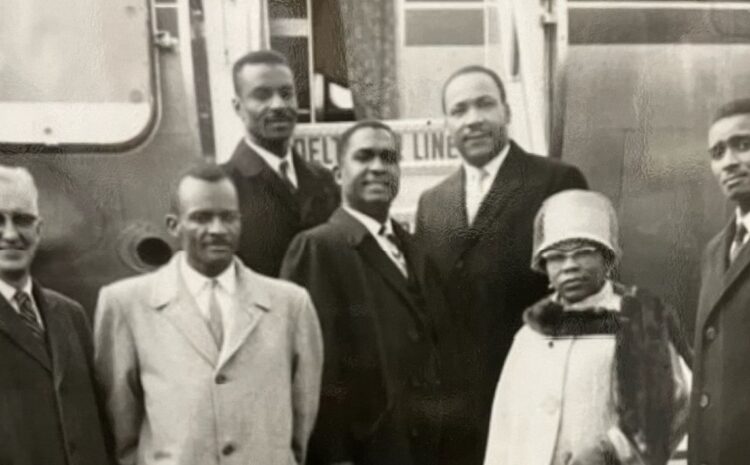
Monday was Martin Luther King Day. Here’s how his activism brought him to Cincinnati
This week, Cincinnati and the rest of the United States will celebrate Dr. Martin Luther King Jr. Day. The holiday, observed federally since 1986, marks a day of remembrance for the Civil Rights leader and a day of reflection on the struggle for racial equality in the U.S.
While King is best remembered for his work elsewhere, his leadership brought him to the Queen City on multiple occasions, leaving a mark on the city through repeated visits, speeches and relationships that helped shape the city’s civil rights trajectory.
According to the Cincinnati Museum Center, King first visited Cincinnati in 1958, speaking at Walnut Hills High School on his 29th birthday. The following year, King returned to Cincinnati, giving a speech at the Emery Theater in support of Theodore Berry’s City Council campaign.
It wasn’t until King’s 1962 appearance in the city, though, that Cincinnati became a regional hotspot for the struggle for racial equality. The Museum Center notes that King returned to the city multiple times, often working closely with local clergy such as Rev. L.V. Booth of Zion Baptist Church and Rev. Fred Shuttlesworth, a national civil rights figure with deep ties to Cincinnati. King spoke in churches across Avondale and Walnut Hills, building coalitions that connected local activism to the broader national movement.
Dr. Martin Luther King Jr.’s most active year in Cincinnati came in 1964, when he made at least four documented appearances in the city, according to the Cincinnati Museum Center. On May 8, King delivered his speech, The Great Revolution, at the African Methodist Episcopal Convention held at Cincinnati Gardens. Later that year, on Sept. 27, King spoke at Music Hall in support of President Lyndon B. Johnson’s presidential campaign. The Cincinnati Museum Center notes that King spent the preceding weekend campaigning in the city’s West End, riding through the neighborhood in the bed of a pickup truck.
On Oct. 22 of the same year, King led a motorcade through Avondale, Walnut Hills and other city neighborhoods alongside fellow civil rights leaders Roy Wilkins, Whitney Young, John Lewis, James Farmer and A. Philip Randolph. The Museum Center’s research suggests King may have remained in Cincinnati through Thanksgiving week, preaching at Zion Baptist Church on Nov. 22 before departing for Dayton on Nov. 29.
King’s final appearance in the city came in 1967 when he addressed members of the Progressive National Baptist Convention, linking the city’s challenges to his growing focus on economic justice and opposition to the Vietnam War.
While King was assassinated 57 years ago, his influence remains visible in annual marches, educational programs and public discussions across the region. What’s more, this past April, the city announced plans for a new statue of Dr. Martin Luther King Jr. to be installed at the longtime MLK memorial site. City leaders say the statue is intended not only as a tribute, but as a reminder of King’s direct connection to Cincinnati and his enduring call for justice and equality.
